MVP vs Prototype vs POC: What Should You Actually Build First?

TL;DR / Summary
Confused about MVP, Prototype, and POC? Learn the key differences, benefits, and when startups should use each before product development.
Table of Contents
- How to Decide What You Should Build First
- Build a POC if...
- Build a Prototype if...
- Build an MVP if...
- What Is the Difference Between an MVP, Prototype, and POC?
- Proof of Concept (POC)
- Prototype
- MVP in Product Development
- Real-World Examples
- Common Mistakes Founders Make with Prototype, MVP, and PoC
- Treating Them as the Same Thing
- Building an MVP Too Early
- Trying to Make the Prototype Perfect
- Adding Too Many Features
- Skipping User Feedback
- Waiting Too Long to Launch
- Which Approach Saves the Most Time and Money?
- Frequently Asked Questions
- 1. Is an MVP the same as a prototype?
- 2. What comes first: Prototype or MVP?
- 3. Does every startup need a POC?
- 4. Can I skip the prototype stage?
- 5. Why is MVP product development important?
- 6. Can an MVP become the final product?
- Conclusion
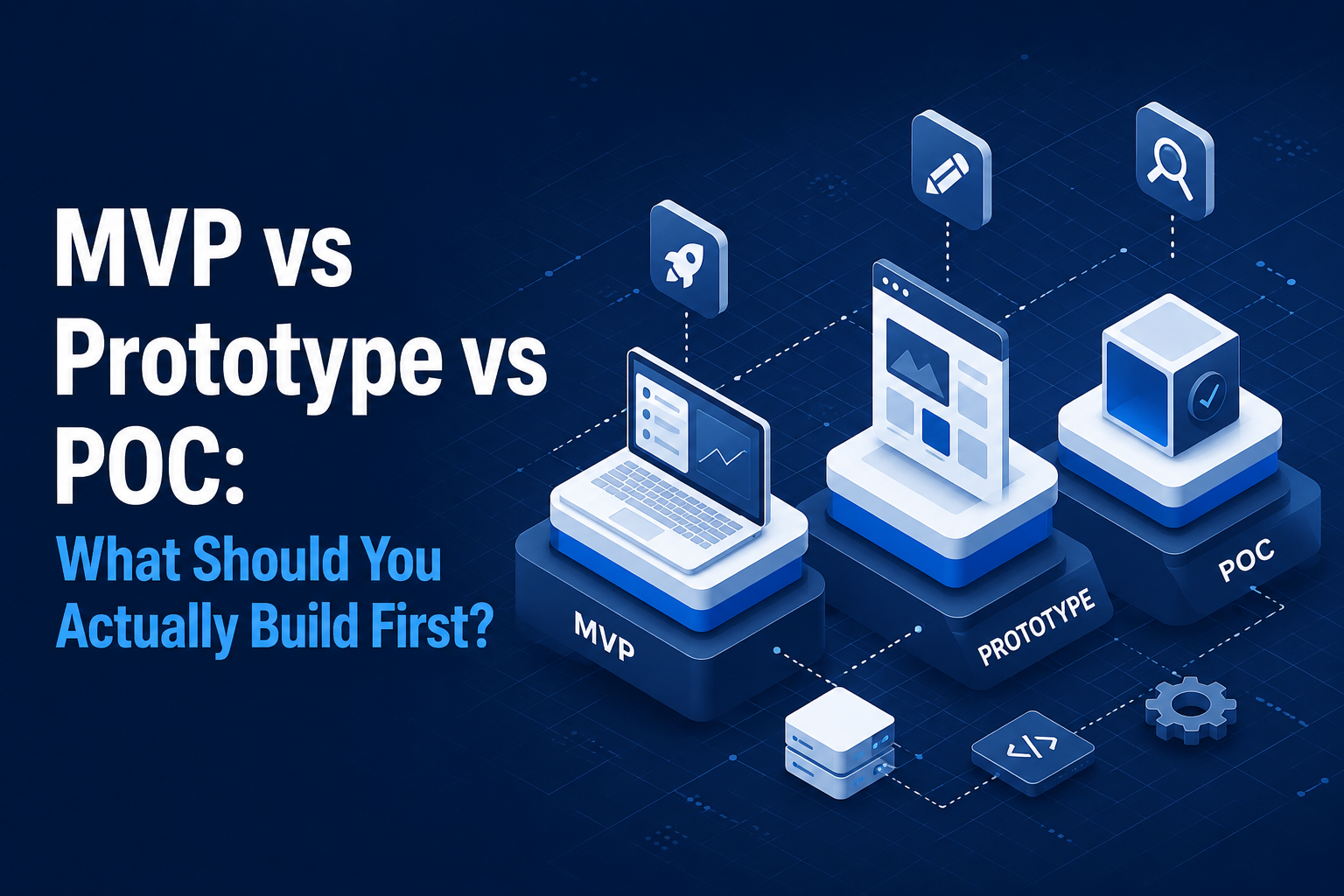
Launching a new product starts with one important question: what should you build first? Many founders and businesses hear terms like MVP, Prototype, and Proof of Concept (POC) used interchangeably, but they serve different purposes.
Choosing the wrong approach can lead to unnecessary development costs, delayed launches, and products that don't solve real user problems. Businesses investing in MVP development services often reduce risk by validating ideas before committing to full-scale product development. The right approach helps you validate your idea step by step before investing significant time and money.
How to Decide What You Should Build First
The best choice depends on your business goal.
Build a POC if...
Your technology hasn't been tested.
You need to confirm technical feasibility.
Your solution involves AI, blockchain, IoT, or other advanced technologies.
Build a Prototype if...
You need design feedback.
You want to test user flows.
Investors or stakeholders need to visualize the product.
Build an MVP if...
Your idea is technically possible.
Your design is validated.
You're ready to test the product with real users.
You want to launch quickly and improve through feedback.
What Is the Difference Between an MVP, Prototype, and POC?
Although all three support product development, they focus on different goals.
Aspect | Proof of Concept (POC) | Prototype | MVP |
Purpose | Test technical feasibility | Test design and usability | Test market demand |
Audience | Internal team | Stakeholders or test users | Real customers |
Functional | Limited or no | Usually no | Yes |
Ready for Launch | No | No | Yes |
Focus | Can it be built? | Will users like it? | Will users use and pay for it? |
Proof of Concept (POC)
A Proof of Concept (POC) is a small experiment that confirms whether your product idea can technically work. It focuses on solving one technical challenge before building the actual product.
For example, if you're creating an AI-powered healthcare application, you may first develop a POC to verify whether the AI model can accurately detect medical conditions from uploaded images.
A POC is typically used only by the internal team and is not shared with customers.
When Should You Build a POC?
Build a POC when:
You're using new technology.
Your product depends on complex integrations.
Technical feasibility is uncertain.
You want to reduce development risk early.
Pros
Reduces technical uncertainty.
Prevents costly development mistakes.
Saves time before full development.
Cons
Cannot be launched.
Doesn't validate customer interest.
Doesn't test user experience.
Prototype
A Prototype is a visual representation of your product that demonstrates how it will look and function. It allows users and stakeholders to experience the design before development begins.
Unlike a POC, a prototype focuses on usability rather than technology.
A prototype may include clickable screens, navigation, and user flows without actual backend functionality.
Types of Prototypes
Low-fidelity sketches
Wireframes
High-fidelity mockups
Interactive clickable prototypes
When Should You Build a Prototype?
A prototype is useful when you need to:
Validate user experience.
Collect stakeholder feedback.
Improve navigation and layout.
Test customer expectations before development.
Pros
Improves product design.
Reduces redesign costs.
Helps gather early feedback.
Aligns teams before development.
Cons
Not a working product.
Cannot validate market demand.
May require multiple revisions.
MVP in Product Development
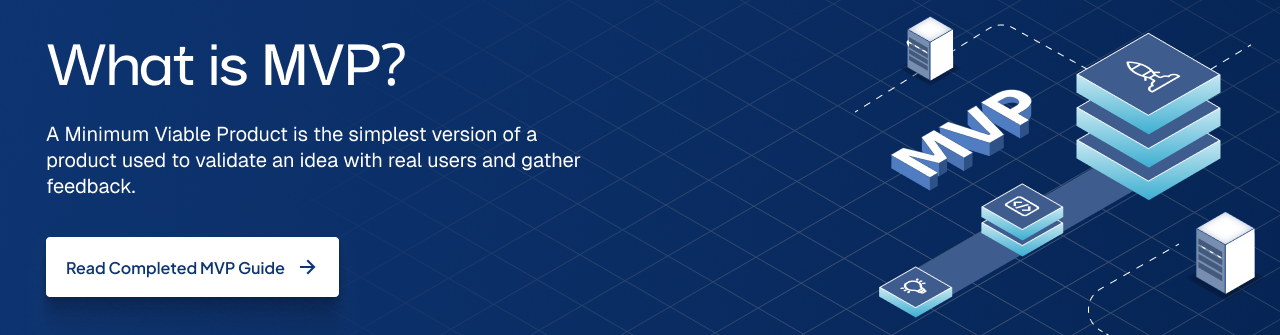
An MVP (Minimum Viable Product) is the first functional version of your product that includes only the essential features needed to solve a core problem for real users.
Unlike a prototype, an MVP is fully usable. Unlike a POC, it is released to actual customers.
The goal of MVP product development is to launch quickly, collect user feedback, and improve the product based on real-world usage instead of assumptions.
What Does an MVP Validate?
An MVP helps answer questions like:
Do customers need this product?
Will they use it?
Which features matter most?
What improvements should come next?
Benefits of MVP Product Development
Faster product launch.
Lower development costs.
Reduced business risk.
Real customer feedback.
Better feature prioritization.
Faster path to product-market fit.
Real-World Examples
Product Idea | Build First | Why |
AI Customer Support Tool | POC | Verify AI performance |
Food Delivery App | Prototype | Test ordering experience |
Fitness Tracking App | MVP | Validate user demand |
Online Marketplace | MVP | Test buyer and seller engagement |
Medical Imaging Software | POC | Validate technical accuracy |
Travel Booking App | Prototype | Improve booking journey |
Common Mistakes Founders Make with Prototype, MVP, and PoC
Many founders choose the wrong approach at the wrong stage. These common mistakes can lead to wasted time, higher costs, and slower product development.
Treating Them as the Same Thing
A Prototype, MVP, and PoC each have a different purpose. Using the wrong one at the wrong stage can waste time, money, and development effort. Choose the approach that matches your current goal.
Building an MVP Too Early
Many founders start building an MVP before proving the idea can work. A simple PoC can help validate the concept first and prevent costly mistakes later.
Trying to Make the Prototype Perfect
A prototype is meant to test ideas, not impress users with a polished product. Keep it simple, focus on the user flow, and avoid spending time on unnecessary details.
Adding Too Many Features
An MVP should include only the features needed to solve the main problem. Adding everything at once delays launch, increases costs, and makes testing harder.
Skipping User Feedback
Building based on assumptions instead of real feedback is a common mistake. Early user testing helps you improve the product before investing more time and money.
Waiting Too Long to Launch
Many startups delay their launch while trying to make the product perfect. Releasing an MVP early helps you learn from real users and improve faster.
Which Approach Saves the Most Time and Money?
Each option helps reduce risk at a different stage.
POC saves money by confirming technical feasibility before development.
Prototype saves money by preventing design changes after development starts.
MVP saves money by validating demand before building advanced features.
Rather than choosing one over another, many successful startups use them in sequence:
Idea → POC → Prototype → MVP → Product Growth
This approach minimizes risk while making informed decisions throughout product development.
Frequently Asked Questions
1. Is an MVP the same as a prototype?
No. A prototype demonstrates the design, while an MVP is a working product that real users can access and use.
2. What comes first: Prototype or MVP?
A prototype usually comes before an MVP because it helps validate the user experience before development.
3. Does every startup need a POC?
No. A POC is mainly needed when the product depends on new or untested technology.
4. Can I skip the prototype stage?
Yes, if your product has a straightforward design and you're confident in the user experience. However, prototypes often help reduce redesign costs.
5. Why is MVP product development important?
MVP product development helps businesses launch faster, gather user feedback, reduce development costs, and validate demand before investing in a full-featured product.
6. Can an MVP become the final product?
Yes. Most successful products begin as MVPs and gradually evolve by adding features based on customer feedback.
Conclusion
There isn't a single answer to whether you should build a POC, Prototype, or MVP first. The right choice depends on what you need to validate.
If you're testing technical feasibility, start with a POC. If you need to refine the user experience, build a prototype. If you're ready to validate your idea with real users, invest in MVP product development.
By choosing the right starting point, you reduce risk, control development costs, and build a product based on real evidence instead of assumptions. That approach leads to smarter decisions, faster launches, and products that better meet customer needs.
Your Product Could Be the
Next Case Study
Explore what we’ve built — and let’s collaborate to create something impactful for your business.
We reply within 24 business hours.