MVP in Agile and Scrum: How It Actually Works

TL;DR / Summary
Learn exactly how MVP fits inside Agile sprints and Scrum cycles. A practical guide for founders and CTOs before you hire a dev team.
Table of Contents
- MVP vs Scrum Increment: The Confusion That Derails Teams
- When to Use MVP, and When Not To
- How to Build an MVP in Scrum: The Actual Workflow
- Step 1: Define your riskiest assumption
- Step 2: Write your MVP hypothesis
- Step 3: Map the minimum end-to-end user journey
- Step 4: Build a lean backlog from that journey
- Step 5: Sprint toward a usable slice, not a complete feature set
- Step 6: Set release criteria before you start building
- Step 7: Release to a controlled group and instrument it
- Step 8: Validate, decide, act
- Who Owns the MVP in a Scrum Team?
- How to Measure Whether Your MVP Succeeded
- The 5 Mistakes That Kill Agile MVPs
- 1. Adding Too Many Features
- 2. Lowering Quality Standards
- 3. Not Defining Success Before Starting
- 4. Testing with the Wrong People
- 5. Ignoring the Results
- From MVP to Full Product: What Happens Next
- FAQs
- 1. What is the difference between MVP and MMP?
- 2. Can a single sprint produce an MVP?
- 3. Who defines MVP scope in Scrum?
- 4. How do you know when MVP feedback is actionable?
- 5. Does MVP always mean a software release?
- Summary
A Minimum Viable Product is the smallest version of your product that produces validated learning from real users. Not the smallest version you can ship. Not the first sprint output. The smallest version that tests a real market assumption with real people behaving in real ways.
That distinction matters more than most teams realize.
The term comes from Eric Ries's Lean Startup methodology (2009), where it describes a learning instrument, a deliberate experiment designed to test whether your core hypothesis about user need is correct before you build the full solution. The word "viable" is doing most of the work here. Viable means it functions well enough for someone to actually use it, form an opinion, and behave in ways you can learn from. A broken feature is not viable. A confusing flow is not viable. A product that requires you to explain it before someone can use it is not viable.
The cleanest definition to carry into your next planning session: MVP is the least you need to build to learn the most important thing you don't yet know.
MVP vs Scrum Increment: The Confusion That Derails Teams
This is where most Scrum teams get stuck, not because they don't know the definitions, but because the two concepts live in different frameworks and the relationship between them is never clearly spelled out.
Here is the distinction, put plainly:
Criteria | Scrum Increment | MVP |
Defined in | The Scrum Guide | Lean Startup/Product Strategy |
Purpose | Deliver progress toward the Product Goal | Test a market assumption with real users |
Must be released? | No. It should be releasable, but the actual release is optional. | Yes, external release is the point |
Scope | One sprint's output | One or more sprints combined |
Feedback target | Product Owner and stakeholders | Real end users in the actual market |
An Increment is a stepping stone. The Scrum Guide says each Increment must be usable, but "usable" in Scrum means complete and without critical dependencies, not "ready for strangers to form real opinions about."
An MVP, by contrast, is what you get when you stack enough Increments to cross the threshold from "internally useful" to "externally testable." That threshold is set by the Product Owner based on what they're trying to learn.
The practical implication:
Can one Increment equal an MVP? Rarely, but yes, if a single sprint produces something genuinely testable by real users.
Is every Increment part of an MVP? Only if the team is building toward an MVP release. An internal system build might stack Increments toward a Product Goal that has nothing to do with market validation.
The most common mistake: a Scrum team calls its Sprint 3 output an "MVP" because it's functional enough to demo. That's an Increment. The MVP is what happens when you put it in front of ten real users who have the problem you're solving, and observe what they actually do.
When to Use MVP, and When Not To
Why this question matters: MVP is a learning tool for situations where the right answer is unknown. It is not the right approach for every product or every team.
Use MVP when:
You're entering a new market, and user demand is uncertain
Requirements will evolve as users interact with the product
Your riskiest assumption is about whether people want this, not how to build it
Speed to feedback matters more than completeness
Budget or runway requires validation before full investment
Skip MVP when:
You're building an internal enterprise tool with fully defined, locked requirements, the "market" is captive, and the feedback loop is already internal
Regulatory or safety constraints require full delivery before release (medical devices, aviation systems, certain fintech products)
You're replacing a system that users depend on daily, partial functionality creates operational risk, and not learning
The product has been validated already, and the team is in delivery mode, not discovery mode
The test to apply before committing to an MVP approach: "What is the riskiest assumption we're making, and can a smaller release test it?" If you can answer that with a clear hypothesis, you're in MVP territory. If every assumption has already been validated and you're building to a known spec, skip the MVP and build.
How to Build an MVP in Scrum: The Actual Workflow
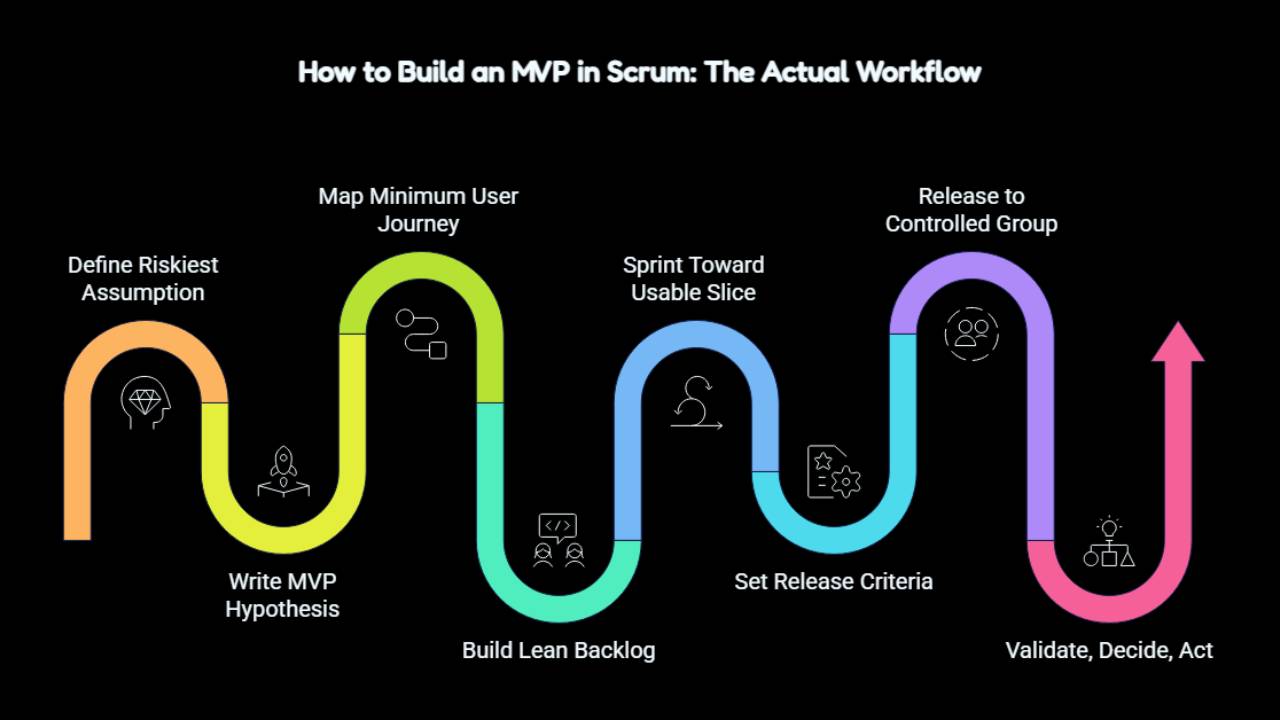
How it works in practice, not as a checklist, but as a series of decisions.
Most step-by-step MVP guides describe execution steps: build a backlog, run sprints, ship, iterate. That's useful, but it skips the harder part, the decision discipline that makes MVP learning actually happen.
Here is the workflow that matters, organized around the decisions you need to make at each stage.
Step 1: Define your riskiest assumption
Before backlog grooming, sprint planning, anything: write down the one assumption that, if wrong, would make your product irrelevant. Not "users will like the interface", that's testable later. The riskiest assumption is usually about demand: "People who experience problem X will change their behavior to solve it using our approach."
This is your Why, the reason the MVP exists.
Step 2: Write your MVP hypothesis
Turn the assumption into a testable statement:
"We believe [target user] will [take this specific action] because [core value we're delivering]. We'll know we're right when [measurable behavioral outcome]."
The measurable outcome is the part most teams skip. Define it here, not after release.
Step 3: Map the minimum end-to-end user journey
Not a feature list. A journey. What does a user do from the moment they arrive at your product to the moment they receive the core value? Every step in that journey must work. Everything outside that journey is out of scope for MVP.
Example: for a task management tool, the minimum journey is: create account → create a task → assign it → mark it done → see it reflected for the team. That's it. Reporting, integrations, notifications, and customization are not in the journey; they're out of MVP scope.
Step 4: Build a lean backlog from that journey
Translate each step in the journey into user stories with focused acceptance criteria. MVP acceptance criteria should answer one question: "Does this step do what the user needs it to do?" Not "is it polished?" Not "does it look finished?" Does it work well enough for someone to move to the next step?.
Anything that isn't on the journey goes in a separate backlog section labeled "post-MVP." This is where the product owner earns their authority; every stakeholder request that isn't on the journey gets redirected there.
Step 5: Sprint toward a usable slice, not a complete feature set
Each sprint should produce something demonstrable, a working section of the user journey, not a partial feature from five different areas. Build end-to-end in thin slices, not layer by layer. A thin slice means: the full journey works, but only for one very basic scenario. Add complexity in later sprints.
This is the principle the Medium/Serious Scrum post argues for: build something usable from Sprint 1. The spirit is right: every sprint should produce something you could, in theory, put in front of a user.
Step 6: Set release criteria before you start building
This is the step most Scrum teams skip and later regret. Before Sprint 1 of the MVP build, the Product Owner and team agree: what conditions make this ready to release as MVP? How many end-to-end journeys need to work without failure? What must be true about reliability, security, or data?
Set it in advance. Scope creep disguises itself as "just one more thing before we're ready." Pre-defined criteria cut through it.
Step 7: Release to a controlled group and instrument it
Who sees the MVP first? Not your board. Not your team. A small, representative sample of actual target users, people who have the problem you're solving, in the context where they'd normally solve it.
Instrument it before release. Define what you'll measure: activation rate, return visits, task completion, support tickets, drop-off points, and willingness-to-pay signals. Passive observation of behavior beats post-release surveys every time.
Step 8: Validate, decide, act
Compare behavior against the success metric you defined in Step 2. Then make one of three decisions:
Persevere: the hypothesis is validated; continue building in the same direction.
Pivot: the problem is real, but your solution isn't right. Reframe the approach.
Stop: the signal is clear enough that this isn't worth continued investment; redirect resources.
The decision must happen. Teams that gather MVP feedback and then continue the original roadmap anyway didn't do an MVP; they did an early release.
Who Owns the MVP in a Scrum Team?
Who is responsible for what is a question that no competitor posts answers directly to, and one of the most common sources of team conflict in MVP builds.
The Product Owner defines the MVP goals and release requirements. They decide when the product is ready to launch. They also prevent unnecessary features from being added. If someone requests another feature before release, the Product Owner follows the agreed requirements and rejects changes that are not required.
The most common failure pattern is that no one is formally empowered to say, "This is enough to release as MVP." Without that authority being explicitly assigned, the committee defers the decision, and the MVP never ships.
The Scrum Master helps prevent new requirements from being added during development. They also lead the post-MVP review to document results and use those insights for the next goal.
The Development Team identifies technical limitations and confirms whether the MVP can be completed within the planned timeline. They should raise issues early if a feature needs more time than expected.
Stakeholders often request additional features before release. The Product Owner should explain that the MVP is a test and avoid adding unnecessary features.
A common reason MVPs are delayed is that no one has the authority to decide when the MVP is ready. This decision should be assigned to a specific person to avoid delays.
How to Measure Whether Your MVP Succeeded
Why this section exists: Every other guide on this topic ends at "ship it and collect feedback." No one defines what feedback would change your decision.
That gap is where most MVP efforts die quietly. Teams ship, get some usage data and some comments, and then continue with the roadmap they already had. That's not validation; it's expensive confirmation bias.
Pre-define success before you build. The success metric must be agreed upon before a single sprint starts, not retrofitted after release to fit whatever happened. If you define it afterward, you will unconsciously select data that confirms your prior belief.
Behavioral metrics beat opinion metrics. "Users said they liked it" is noise. "Users returned three times in the first week without being prompted" is a signal. Behavior is honest; opinions are polite.
Three tiers of signal to measure:
Signal tier | What to measure | Why it matters |
Activation | Did users complete the core journey? | Tells you if the MVP solves the stated problem |
Retention | Did users return without being reminded? | Tells you if the value is real enough to repeat |
Commitment | Did users pay, recommend, or ask for more? | Tells you if the market signal is strong enough to build on |
You don't need all three in the first MVP. Decide which tier is most relevant to your hypothesis and measure that one rigorously.
The pivot/persevere/stop framework:
Before release, agree on thresholds. For example:
If 40% of users complete the core journey in Session 1 → persevere
If completion is under 20% →, interview users and pivot the journey
If under 5 users return after Session 1 among 50 released → stop and reframe the problem
The numbers are yours to set. The discipline is non-negotiable: the decision criteria must exist before release, or the feedback loop is just theater.
One more distinction worth making: learning and validation are not the same thing. Learning means you now understand something you didn't before, even if you learned your hypothesis was wrong. Validation means your hypothesis was tested and confirmed. Both are valuable. Neither happens without pre-defined criteria.
The 5 Mistakes That Kill Agile MVPs
These aren't abstract principles. They are patterns that show up in real sprints, real retrospectives, and real post-mortems.
1. Adding Too Many Features
When everyone keeps adding “just one more thing,” the MVP loses its purpose. Focus on testing one idea at a time and avoid adding unnecessary features.
2. Lowering Quality Standards
An MVP should be simple, but it should still work properly. Broken features, bugs, and confusing user experiences make it difficult to get useful feedback.
3. Not Defining Success Before Starting
Before releasing an MVP, decide how you will measure success. Without clear goals, it becomes difficult to understand whether the product is working or not.
4. Testing with the Wrong People
Feedback should come from the people who would actually use the product, not just colleagues, stakeholders, or friends. Real users provide more useful insights.
5. Ignoring the Results
Collecting feedback is only helpful if you use it. Review the results and make decisions based on what you learn instead of continuing with the original plan without changes.
From MVP to Full Product: What Happens Next
Where teams go after the MVP is validated is a question that's rarely answered and always relevant.
Every guide on MVP ends at "iterate based on feedback." That's accurate but incomplete. Here is what the transition actually looks like in a Scrum context.
Three post-MVP paths:
Persevere and scale: Your hypothesis was validated. Users completed the journey, returned, and showed signs of commitment. Now the backlog shifts: you move from hypothesis-driven user stories ("test whether users will do X") to demand-driven refinement ("users are doing X and asking for Y, build it"). The sprint goal changes from "validate" to "extend."
Pivot: You validated a real problem, but invalidated your solution. Users have the pain you expected, but your product didn't solve it the way you thought. This is not failure; it's learning. A pivot means reframing the solution, not abandoning the market. The MVP gave you something far more valuable than a win: it gave you specific evidence of where the gap is.
Stop: The signal is unambiguous; the problem isn't as real, as urgent, or as common as assumed. Stopping based on MVP data is not a failure. It's the MVP doing exactly what it was designed to do: preventing a larger, more expensive failure further down the road.
One concept worth knowing: the MMP
After MVP comes the Minimum Marketable Product, the point where the product is valuable enough to sell broadly or scale, not just learn from. The MVP tests whether you have a problem worth solving. The MMP tests whether you have a solution worth selling. They are different milestones and require different release criteria.
The Product Owner's role evolves between them: from "define the test and hold the scope" to "interpret the data and set the next Product Goal." Both are critical. Neither is optional.
FAQs
1. What is the difference between MVP and MMP?
An MVP (Minimum Viable Product) is a basic version of a product used to see if people find it useful and to gather feedback. An MMP (Minimum Marketable Product) is a more complete version that is ready to be sold to customers and shared with a wider audience.
2. Can a single sprint produce an MVP?
Sometimes, but not often. If a small set of features is enough to test the idea with real users, one sprint can produce an MVP. The key requirement is that it must be ready to use and able to collect real user feedback. Most products usually need 3–6 sprints before reaching that stage.
3. Who defines MVP scope in Scrum?
The Product Owner decides what is included in the MVP. The team provides input on technical limitations, and stakeholders can share their requirements, but the Product Owner makes the final decision on what is included now and what can be added later.
4. How do you know when MVP feedback is actionable?
Feedback is useful when it helps you make a clear decision: continue, make changes, or stop. If the feedback is unclear, comes from too few users, or there is no clear way to measure success, more testing may be needed before making the next decision.
5. Does MVP always mean a software release?
No. An MVP does not always have to be a software product. It can be a video, a landing page, a manual service, or a series of user interviews.
Summary
The biggest challenge with an MVP in Scrum is not building it, but staying focused on its purpose. Before starting, teams should clearly define what success looks like and be ready to act on the feedback they receive.
Many teams can build an MVP, but it becomes difficult when extra features keep getting added. A successful MVP focuses only on testing the main idea. Before planning your next sprint, ask yourself: What is the one assumption that could change everything if it turns out to be wrong? Build only what is needed to test that idea and learn from the results.
Your Product Could Be the
Next Case Study
Explore what we’ve built — and let’s collaborate to create something impactful for your business.
We reply within 24 business hours.