

Enterprise LLM Guide: Architecture, Operations, Security, and ROI

Written by
NetizensNovember 13, 2025
16 min read
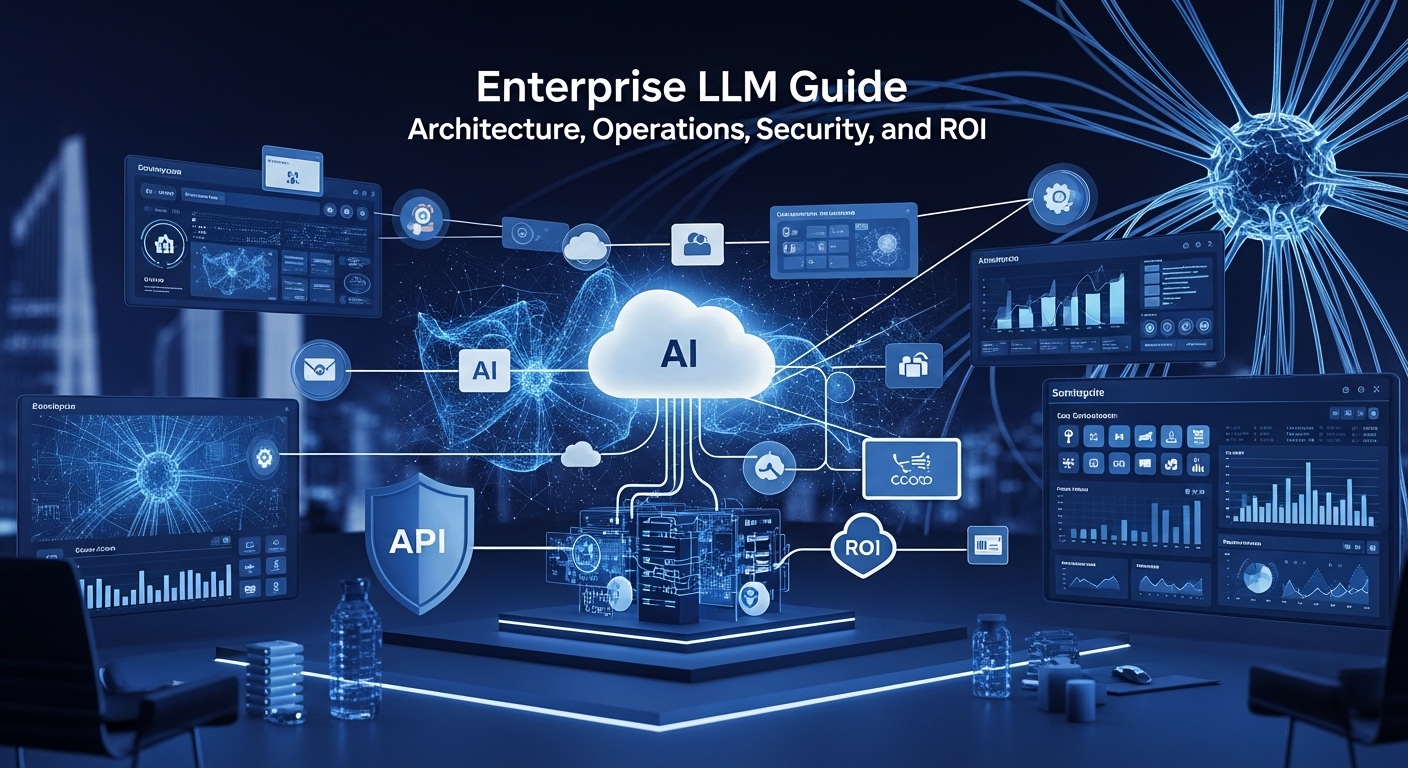
Enterprise businesses have long been restricted by the formation of data silos across their operations. These obstacles fragment businesses, separating sales, customer support, marketing, inventory, and finance departments. Imagine the potential these businesses could unlock by aligning data from throughout their departments. They wouldn’t just make decisions quickly, as they would be backed by data intelligence.
Pairing company-wide data with the abilities of artificial intelligence and enterprise operations becomes streamlined and smoother. This is where an enterprise LLM becomes a tool that enterprises shouldn’t do without. Trained on company data, these systems can quickly adapt to company tone, context, products/services, and operations. This allows for personalization,
This blog explores enterprise LLM, its benefits, challenges, and how it differs from traditional LLM models.
What is an LLM?
A Large Language Model (LLM) is an AI system that is designed to generate and work with human-like language through training on vast datasets.
Through these datasets, the model will be able to understand and identify patterns, context, grammar, and the intricacies of human language.
These systems are built upon a “transformer” architecture, which breaks down complex text into smaller “tokens” to facilitate understanding.
LLM utilizes a form of machine learning called deep learning, which enables it to comprehend the interplay between words and sentences. Eventually, this deep learning will allow the LLM to recognize patterns without human intervention.
Uses of LLMs
A large language model can execute various tasks depending on its training data and fine-tuning. The array of functions suited to trained LLMs is:
- Online search
- Content creation
- Chatbots
- Sentiment analysis
- Code generation
The benefits of AI-powered chatbots for customer support are numerous, saving time, personalizing responses, and sparing staff from excessive manual work.
Additionally, developers can overcome coding challenges and accelerate development with assistance from an LLM.
What is Enterprise LLM?
Enterprise LLMs have become a vital asset for large businesses seeking to enhance efficiency, personalize customer support, and boost ROI.
However, getting the best out of these models requires intelligent deployment and responsible management. Doing so will ensure its system is grounded in the company’s system, with a prioritization of workflows, costs, compliance, and control.
Traditional LLMs are trained on content retrieved from the internet. Using this, it develops power in general language reasoning. In case of company-specific situations, they don’t return any specialized responses that are accurate and can be traced back to raw company data.
Enterprises cannot afford to use such vague, incorrect, and unpredictable traditional LLM responses. Through integration, monitoring, and acknowledgement of data perimeters, these LLMs can be modified.
With these modifications, enterprise LLMs can improve code development speed, draft legal contracts, personalize and accelerate customer support ticket resolution.
“Enterprise LLMs are tailored to meet business requirements. Their general language reasoning is blended with company-specific data to provide tailored solutions that meet the company’s requisites and interests.” c
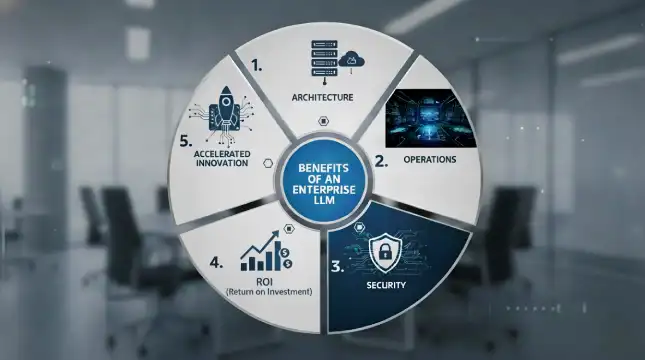
Architecture of Enterprise LLM
Most enterprise LLMs use advanced AI models to ensure these systems understand and generate human-like language. This ensures they can be easily fitted and integrated with a company’s existing systems.
Core Characteristics
- An enterprise LLM is preferred for its ability to handle thousands of requests without slowing down.
- Because it integrates with CRMs, chatbots, and tools like Slack, it causes little operational disruption.
- Training this software on company data can lead to greater understanding and alignment with the company’s products, terminology, and communication tone.
Benefits
- The enhanced data accessibility created by enterprise LLMs eliminates and prevents the formation of data silos.
- It empowers a company to connect through its various systems.
- The easy transfer of data enables teams to stay informed and collaborate through co-development software when necessary.
Operations of Enterprise LLM
Enterprise LLMs are designed to simplify and streamline daily operations with efficiency. These systems accomplish such tasks through automation, saving staff time and effort.
The tasks these modified systems undertake are report generation, summarizing content, compiling data, and generating data-driven insights.
Core Characteristics
- Real-time data insights from enterprise LLMs allow for instant answers that enable employees to make decisions faster.
- By continually learning through analysis of company data, an enterprise LLM becomes more effective at supporting business operations over time.
- Delegating time-consuming tasks to the LLM can give companies a clear opportunity to reduce overhead costs and utilize the saved time for other projects.
Benefits
- Converting repetitive, manual processes into automated processes will save time.
- Enterprise LLMs work to improve and increase output, enabling resources to be placed in high-value tasks.
- It facilitates accurate and consistent decision-making backed by data.
Security of an Enterprise LLM
Given that enterprise LLMs are trained on confidential data, they are built with advanced protection and privacy layers. These are continuously tested and updated to prevent breaches and misuse.
Core Characteristics
- Particular data is only made accessible to authorized employees or management.
- Depending on the industry and specific regulation, it’s compliance-ready, complying with HIPAA or GLBA data protection regulations.
- An enterprise LLM is designed to ensure that confidential information never mixes with public information.
Benefits
- Aids enterprises in keeping massive volumes of data private and safe from leaks or unauthorized misuse.
- It supports compliance responsibilities and aligns with global data protection regulations.
- These systems work to develop stronger bonds between clients and stakeholders.
ROI (Return on Investment) of Enterprise LLM
Given the above benefits, enterprise LLMs have an impact on a company’s ROI. Improved time and efficiency equate to financial benefits. Enterprises will look to lower expenses wherever possible, but without compromising quality.
Core Characteristics
- Because not all processes are dependent on manual work, certain processes experience fewer delays.
- The beneficial status of an enterprise LLM becomes evident over time after it has had time to learn and improve.
- In-built performance tracking enables tracking of hours saved, sales conversions, and other metrics.
Benefits
- Faster and more accurate data-driven decision making.
- Improved productivity due to automation and more time available for high-value tasks.
- Personalization enhances customer satisfaction, improves retention, and increases revenue.
Accelerated Innovation of Enterprise LLM
Large companies require constant innovation to improve efficiency and prevent negative impacts. Enterprise LLMs are a tool that enables enterprises to implement innovation but gradually, without interrupting operations.
Core Characteristics
- Enterprise LLMs help businesses identify and define in simple terms what they require.
- These simple and understandable requirements make it easier and less complicated to explore new processes and ideas.
- The unified system enables teams to collaborate on designing, testing, refining, and launching ideas using AI-based insights.
Benefits
- An enterprise LLM leads to faster research and development cycles within larger companies.
- It helps to encourage staff to explore creativity and experimentation in a manner that prioritizes progress.
- Active innovation permits companies to stay ahead of their competitors.
Cons of Enterprise LLM
There is no denying the effectiveness of an enterprise LLM in streamlining operations and facilitating decision-making.
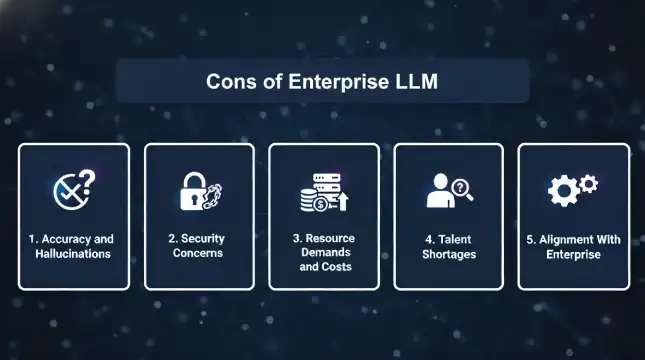
1. Accuracy and Hallucinations
Regardless of how much data an enterprise LLM is trained on, there is the possibility of inaccuracies. Accurate-sounding yet unverified ‘hallucinations’ are unacceptable in niches like Finance, Healthcare, and Law.
Also, some enterprise LLMs may be limited by the restricted data used for training. Making decisions based on this outdated or incorrect data can leave an enterprise facing dire legal and financial consequences.
2. Security Concerns
Although enterprise LLMs are built with extra layers of protection, it may not be enough! By using an LLM, companies always run the risk of accidentally exposing private data publicly.
There are also opportunities for data to be stolen through the manipulation of prompts, data poisoning, and even model theft. Another risk is that of the potential for training data to instill bias in the LLM, leading to long-term, possibly undetected discrimination.
3. Resource Demands and Costs
High computational costs and immense infrastructure requirements make an enterprise LLM an asset not all companies can afford. Scaling such a system can be complicated, and companies may experience operational lapses without the right resources.
Companies lacking the infrastructure of larger enterprises may think twice before implementing enterprise LLMs. It would be unwise to integrate an enterprise LLM only to find that maintenance costs more than the company can manage.
4. Talent Shortages & Integration Challenges
Hiring professionals capable of maintaining and building enterprise LLMs can be tough due to market skill gaps.
The costs of hiring and training data scientists, security experts, and AI engineers can be high. The inability to find the right staff to maintain and update an enterprise LLM can lead to delays, which impact operations.
5. Alignment With Enterprise
Besides being accurate and safe, large language models must deliver output that aligns with the company. Not only should the results satisfy the prompt or request, but they should also match the company’s tone.
This is particularly difficult for businesses implementing an LLM for the very first time. Getting the large language model to output material that is perfectly aligned can be problematic without the appropriate resources.
Challenges of Integrating an Enterprise LLM
Although the possibilities are immense, numerous challenges inhibit the faster adoption of enterprise LLM.
1. Ensuring Accuracy
Initially, in the implementation process, nothing is more crucial than ensuring the LLM is generating accurate data. Without accuracy, the data won’t be able to aid decision-making or improve business revenue.
That said, businesses must ensure the integration process is effective to avoid hallucinations. However, it is a concern when integrating an LLM into the backend of your application. Relying on incorrect data can put the company in jeopardy.
2. Prioritizing Safety
Seamless governance and oversight are necessary to ensure the generated content doesn’t pose any potential business risk.
Reports, ideas, summaries, and any other form of content from the enterprise LLM shouldn’t cause concerns, legal or otherwise. Using content without safety measures could cause complications for the business.
3. Synchronizing LLMs with Enterprise Requirements
Ensuring the LLM is correctly synchronized with the enterprise is crucial. Without it, the LLM is unlikely to give enterprises the in-depth, context-based intelligence needed to match the company’s tone.
This doesn’t just require the LLM to gain access to the company’s data, but an in-depth understanding of the company’s processes, requirements, and data in the context.
4. Initiating Cost Saving Steps
For the first time, setting up and programming these models can be a costly action for an enterprise.
In the case of some companies, continuing the process of collecting and storing data isn’t logical due to the immense cost of resources. At this point, an enterprise LLM would appear to be a liability if it isn’t returning business-changing results.
5. Usability of Generated Content
A further challenge appears when the output fails to meet the enterprise’s expectations. The output also becomes useless when it is outdated or factually incorrect.
Decision-making based on outdated data can lead to broader business implications. The inability to customize output based on customer data can inflict customer service and support issues.
Overcoming Common Enterprise LLM Challenges
The initial stages of building and maintaining the model are difficult. However, solving these enterprise LLM challenges can make a massive long-term difference.
Design a Transparent Strategy
Walking into something blindly rarely leads to success. That’s why it’s critical to establish a clear strategy. A step-wise approach will enable companies to follow the steps and identify their goals in order of importance.
This step will help balance the pros against the cons, enabling companies to decide if they truly need this LLM.
Discuss Your Needs With Experts
Most companies looking to develop enterprise LLMs for the first time make many avoidable mistakes from the start.
These mistakes don’t have to be made, and there’s an easy way to learn what lies ahead. Discussing your ambitions with experts can help. It is certainly one way of making fewer mistakes.
Implement in Stages
Instead of going all in through a single phase, companies can break down the process into several stages. Enterprises can choose to split the process into smaller, doable phases.
Initially, the project can take shape through a minimum viable product ( MVP). This stage tests the market, gathers feedback, and sees the idea in action.
After gathering enough information, enterprises would work on personalization and further develop the product’s capabilities.
Understand the Short-Term & Long-Term Requirements
Before setting up an enterprise LLM, ensure you understand what the model requires. This refers to the infrastructural requirements and expertise needed to establish, fine-tune, and maintain such systems.
This will prepare the company for all the expenses and requirements that accompany the use of enterprise LLMs.
Implementing Retrieval-Augmentation Generation (RAG) in Enterprise LLM
Enterprise LLMs aren’t deployed in isolation, as their true potential cannot be leveraged. However, when deployed with Retrieval-Augmentation Generation, result accuracy is enhanced.
Enterprise RAG development for enterprises involves building a rich knowledge base of personalized and relevant data. With the ability to retrieve relevant, context-specific data, RAG builds upon the already powerful capabilities of an LLM.
Steps involved in implementing an RAG in an enterprise LLM include:
- Understanding RAG & its Benefits: Gaining a firm understanding of RAG and its benefits is paramount. Knowing this then enables you to align your business requirements with the RAG capabilities.
- Build Your Knowledge Base: Collect and create a collection of data consisting of business documents and databases. Ensure the information is placed into smaller, manageable pieces through a process called “chunking.” These smaller pieces of text should be converted into a numerical representation and stored in a vector database for future efficiency.
- Implement the Retriever and Generator Pipeline: Set up the pipeline to retrieve the most relevant data from the vector database and send it to the LLM to generate an appropriate and accurate response.
- Add Refinement for Optimization: Certain elements need to be added to ensure the LLM remains effective. Guardrails will ensure responses remain refined and on topic. Metrics will gauge the efficiency and quality of the responses. Citations keep responses accurate by quoting the original data source.
Enterprise LLMs aren’t effective without the Retrieval-Augmentation Generation framework, and to an extent, it decides how useful the data is.
Difference Between an Enterprise LLM & a Traditional LLM
While enterprise LLMs are specialized LLMs, the differences between them are extensive.
| Feature | Enterprise LLM | Traditional LLM |
| Purpose | Designed for businesses & specialized processes. | Built for general use. |
| Data Source | Trained & fine-tuned on company data. | Trained using generic & public data. |
| Customization | Highly customizable to suit the business | Limited or no customization. |
| Integration | Connects with enterprise tools such as CRM, ERP, HRMS, etc. | Exist as standalone apps or as a chatbot. |
| Compliance | Meets enterprise data protection & regulatory standards. | Not compliance certified for business use. |
| Support & Maintenance | Requires persistent maintenance, monitoring, & performance refinement. | Platform-level updates only. |
| Performance | Regularly optimized to improve performance. | Rarely retrained for custom contexts. |
| Data Ownership | Data stays in the company’s control. | Data could be stored by the AI provider or processed externally. |
| Collaboration | Facilitates effective collaboration across the company. | Single-user operation only. |
| Infrastructure | Extensive infrastructural requirements. | Low infrastructural requirements. |
| Cost & ROI | High setup costs, but ROI is worthwhile in the long term. | Minimal to low setup costs and accessible for free or through subscriptions. |
Why Partner With Netizens Technologies for Your Enterprise LLM?
Netizens Technologies has been developing customized IT solutions that help elevate businesses for a long time. Our website, application, and custom software development services are tailored to reduce manual work, facilitate innovation, and improve decision-making.
Our AI-centric software, like enterprise LLM, helps businesses collaborate and operate more effectively by breaking down data silos. It also enables faster and more accurate decision-making by generating reports and real-time insights.
With a professional team of IT and AI experts and a reputation for excellence, Netizens Technologies makes solutions that address your business problems.
We won’t stop at developing a tailored LLM for you; we offer ongoing support and maintenance if you need them.
Conclusion
Success in the current market doesn’t just rely on collecting data and using the latest technology. It hinges on a company’s ability to harness technology in extracting intelligence from data. Achieving this enables your teams to act faster, utilize time more efficiently, and collaborate and innovate seamlessly.
Amid such uncertain times, enterprises are required to lead the charge, and in this case, embracing AI is the way forward. Innovating and automating are the way forward to getting ahead of the competition.
To start working on an enterprise LLM that serves your business’s precise needs, connect with an expert like Netizens Technologies.
FAQs
1. What is the use of enterprise LLM?
2. Can I develop a custom enterprise LLM for my business?
3. Why is LLM so popular?
4. What are the three parts of LLM?
5. What is the point of an LLM?
6. What does LLM mean in business?




Written by
Netizens



Let's Start Your Project
Get free consultation for your digital product idea to turn it into reality!
Get StartedRelated Blog & Articles

Netizens
March 6, 2023
How Artificial Intelligence Is Transforming the World in 2026 and Beyond
Imagine a society in which your city knows exactly when to send an ambulance, your doctor
Netizens
March 25, 2024
What is HubSpot ?
What is HubSpot? HubSpot is a comprehensive inbound marketing and sales software platform designed to help

Netizens
July 23, 2024
How IT Consulting Support Services Can Help Small Businesses Grow
There’s no denying that technology plays a central role in businesses today. Unfortunately, due to challenges