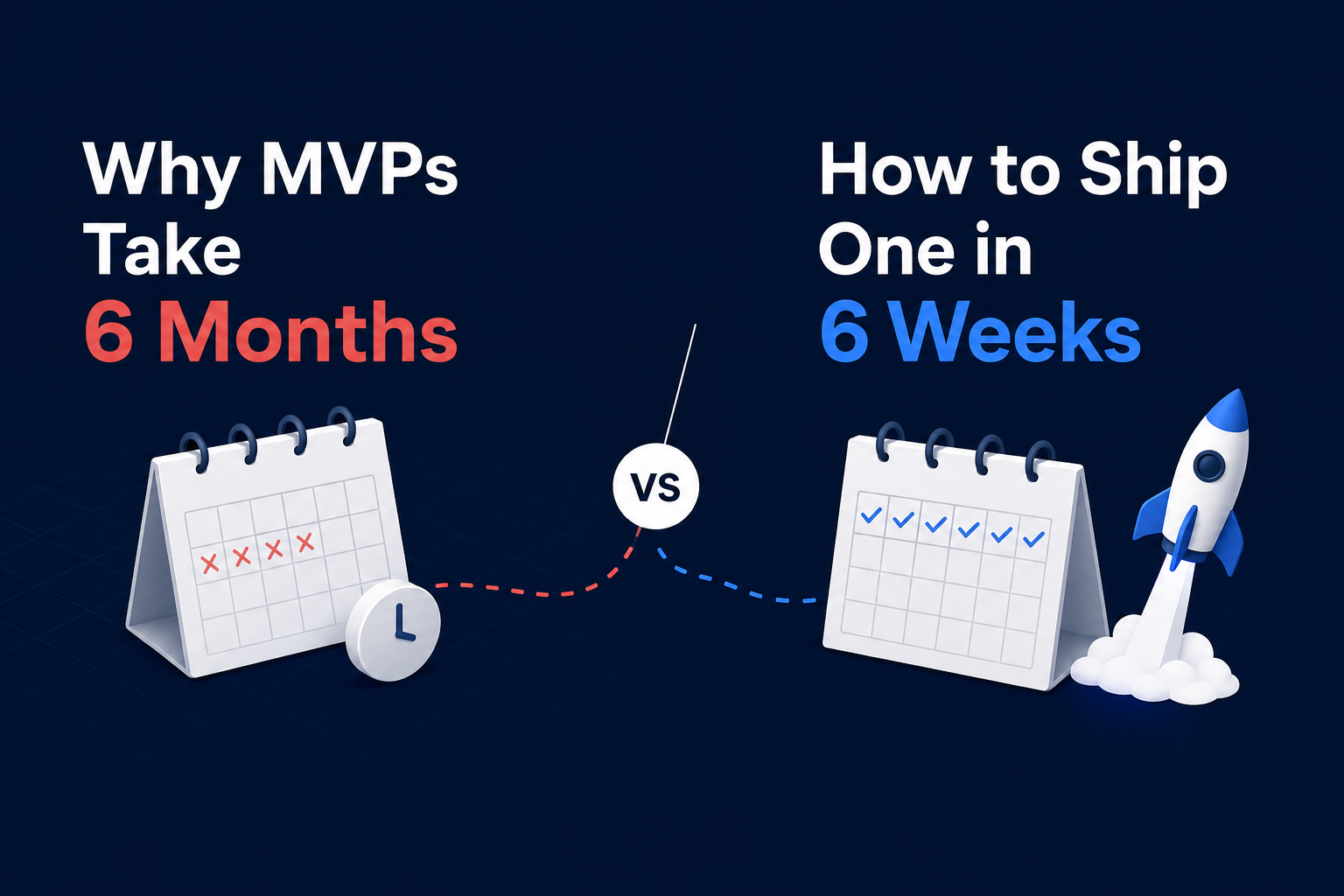
Why MVPs Take 6 Months, and How to Ship One in 6 Weeks

TL;DR / Summary
Why do MVPs take 6 months? Learn the common causes of MVP delays and how a focused six-week development approach can help you launch faster.
Table of Contents
- Why Do MVPs Take 6 Months Instead of 6 Weeks?
- What Causes MVP Development Delays?
- 1. Scope Keeps Growing
- 2. Building for Future Scale Too Early
- 3. Supporting Too Many User Journeys
- 4. Over-Designing the MVP
- What Is the Real Purpose of an MVP?
- How Is a 6-Week MVP Different From a 6-Month Build?
- What Can You Actually Build in 6 Weeks?
- Products That Can Often Fit a 6-Week MVP
- Products That May Need More Time
- How Does a 6-Week MVP Framework Work?
- Weeks 1–2: Define the Scope and Set the Foundation
- Weeks 3–4: Build the Core Workflow
- Weeks 5–6: Test, Refine, and Launch
- What Technical Choices Help Keep an MVP Under 6 Weeks?
- 1. Keep the Architecture Simple
- 2. Use Established Frameworks
- 3. Use Managed Infrastructure
- 4. Use Proven Third-Party Services
- How Do You Decide What Belongs in an MVP?
- How Can You Prevent Scope Creep During Development?
- Set One Decision-Maker
- Use a Post-Launch Backlog
- Use an "Add One, Remove One" Rule
- Freeze the Core Scope
- How Does a Longer MVP Timeline Affect Startup Costs?
- How Do You Move From a Prototype to a Production MVP?
- Step 1: Document the Validated User Flow
- Step 2: Review the Existing Architecture
- Step 3: Fix the Data Model
- Step 4: Strengthen Security
- Step 5: Replace Fragile Components
- Step 6: Test the Core Workflow
- What Should You Do After the MVP Launches?
- FAQs
- Is six weeks enough time to build an MVP?
- Should I build a web app or mobile app for my MVP?
- Can I build an MVP with no-code or AI development tools?
- What should happen after an MVP launches?
- Conclusion: Should You Build Your MVP in 6 Weeks?
Building an MVP shouldn't mean spending six months developing a product before anyone gets to use it.
Yet that's exactly what happens to many startups. A small initial idea turns into dozens of features, multiple user roles, complex integrations, polished dashboards, and architecture designed for a scale the product hasn't reached yet.
The result? The MVP becomes a full product before the team has validated whether customers actually want it.
A focused MVP can sometimes be shipped in six weeks when the scope is narrow, the core workflow is clear, and the technical requirements are manageable.
The goal isn't to build less carefully. It's to build only what you need to learn what happens next.
Why Do MVPs Take 6 Months Instead of 6 Weeks?
MVPs rarely take six months because every individual feature requires months of development.
They take that long because the scope keeps expanding.
A typical project can start with:
"We need one workflow that solves this customer problem."
A few weeks later, it becomes:
Multiple user types
Advanced dashboards
Social login
Custom notifications
Payment systems
Admin panels
Multiple integrations
Advanced analytics
Mobile applications
Complex permissions
Custom design systems
None of these features may be inherently bad.
The problem is building them before validating the core product idea.
A simple development cycle can quickly become:
Feature requests → Scope expansion → More development → More testing → More dependencies → Delayed launch
A focused MVP follows a different path:
Core problem → One user journey → Essential functionality → Early users → Feedback → Iteration
The second approach gives the business something valuable much earlier: real-world evidence.
What Causes MVP Development Delays?
1. Scope Keeps Growing
Adding features that aren't essential to the core product can quickly extend the timeline.
Before adding a feature, ask:
Does this help us validate the core product idea?
If not, move it to the post-launch backlog.
2. Building for Future Scale Too Early
Using complex architecture, microservices, or advanced infrastructure before the product has enough users adds unnecessary development time.
For an MVP, choose a simple, reliable architecture that can support current needs. Scale it when real usage requires it.
3. Supporting Too Many User Journeys
Building multiple roles, dashboards, and workflows at once makes an MVP much harder to develop.
Instead, identify one primary user and one core journey that demonstrates the product's value. Build that first.
4. Over-Designing the MVP
An MVP needs to be usable, clear, and reliable, not perfect.
Prioritize:
Simple navigation
Responsive design
Clear user flows
Consistent UI
Save advanced animations, complex dashboards, and visual refinements for later iterations.
What Is the Real Purpose of an MVP?
An MVP isn't a smaller version of the final product. Its purpose is to test whether your core product idea solves a real user problem before you invest heavily in development. This approach focuses on building only the functionality needed to provide value while leaving room to test and iterate based on real-world use.
For example, if you're building a workflow automation platform, you don't need multiple automation types, advanced analytics, or numerous integrations at launch.
You may only need:
User → Select workflow → Configure action → Run automation → See result
If users don't find this core workflow valuable, adding more features won't solve the underlying problem.
The goal of an MVP is to learn quickly, validate demand, and use real user feedback to decide what to build next, not to achieve feature completeness.
How Is a 6-Week MVP Different From a 6-Month Build?
Factor | Longer Build | Focused 6-Week MVP |
Primary goal | Feature completeness | Validate the core idea |
Users | Multiple personas | One primary persona |
Features | Broad feature set | Essential features |
User journeys | Multiple | One core workflow |
Architecture | Designed for future scale | Appropriate for current needs |
Integrations | Many | Only essential integrations |
Feedback | Often delayed | Gathered early |
Launch | Large public release | Controlled initial release |
Roadmap | Built upfront | Adjusted using feedback |
The important difference isn't simply six months versus six weeks.
It's the decision to validate before expanding.
What Can You Actually Build in 6 Weeks?
A six-week MVP is realistic when the product has a clear core workflow, limited features, and manageable technical requirements. The goal is to launch a usable version that can be tested with real users, not a complete product.
Products That Can Often Fit a 6-Week MVP
SaaS dashboards and customer portals
Internal business tools
Simple booking or marketplace platforms
Workflow automation tools
AI-powered business applications
Basic web-based products
Products That May Need More Time
Products with greater technical, regulatory, or infrastructure requirements may need a longer timeline, such as:
Hardware-dependent applications
Highly regulated products
Complex fintech platforms
Large multi-sided marketplaces
Real-time systems with complex infrastructure
Applications requiring extensive offline functionality
How Does a 6-Week MVP Framework Work?
A focused six-week MVP can be divided into three two-week phases, with each phase moving the product closer to a usable launch.
Weeks 1–2: Define the Scope and Set the Foundation
Start by clearly defining:
Who the first user is
What problem you're solving
What core workflow delivers value
Then finalize the MVP scope, map the user journey, choose the technology stack, and set up the development environment.
The priority is deciding what to build, and what to leave out.
Weeks 3–4: Build the Core Workflow
Build only the functionality required for the primary user to complete the core task.
Focus on the essential:
Screens and user flows
Backend logic
Database
Required integrations
By the end of week four, the main workflow should work from start to finish.
Weeks 5–6: Test, Refine, and Launch
Use the final two weeks to make the MVP reliable enough for real users.
Focus on:
End-to-end testing
Authentication and data validation
Critical bug fixes
Error handling
Production setup
Deployment
Basic user onboarding
The goal is not a finished product. It's a reliable first release that can reach users and generate real feedback.
What Technical Choices Help Keep an MVP Under 6 Weeks?
The right technical choices can reduce development time and keep the MVP focused. The goal is to use reliable, proven solutions instead of building unnecessary complexity from scratch.
1. Keep the Architecture Simple
Use a straightforward architecture, such as a monolith, when it meets the product's current requirements.
Avoid introducing microservices or complex infrastructure unless there's a clear technical need.
Build for today's requirements, not hypothetical future scale.
2. Use Established Frameworks
Choose mature frameworks and libraries for common functionality such as:
Authentication
APIs
Database access
Validation
Testing
This reduces custom development and lets the team focus on the product's core functionality.
3. Use Managed Infrastructure
Use managed cloud and platform services where appropriate to reduce infrastructure setup and maintenance.
This allows developers to spend more time building customer-facing functionality instead of managing infrastructure.
4. Use Proven Third-Party Services
Don't build supporting functionality from scratch when reliable services already exist.
Depending on the product, use established services for:
Payments
Email and SMS
Authentication
File storage
Analytics
Evaluate each service for security, reliability, cost, and long-term fit before integrating it.
How Do You Decide What Belongs in an MVP?
One of the hardest parts of building an MVP is deciding what to leave out. Every feature should have a clear purpose and support the product's core goal.
For each proposed feature, ask:
Does it help the user complete the core workflow?
If yes, consider including it.
If not, is it essential for security, compliance, or basic usability?
If yes, include it.
If no, defer it until after launch.
This gives you three simple priorities:
Must Have → Should Have → Later
For a six-week MVP, focus primarily on Must Have features. Keep everything else in the post-launch backlog unless real user feedback shows it needs to move up.
How Can You Prevent Scope Creep During Development?
Scope needs to be controlled throughout the project, not just during kickoff.
Here are four practical rules.
Set One Decision-Maker
Someone should have final authority over feature decisions.
Without clear ownership, every stakeholder can introduce another "small" requirement.
Those small requests eventually become a large scope increase.
Use a Post-Launch Backlog
Don't reject every future idea.
Capture it.
Create a backlog for:
Nice-to-have features
Additional integrations
Design improvements
Edge cases
Advanced reporting
Additional user roles
This keeps good ideas without allowing them to disrupt the current release.
Use an "Add One, Remove One" Rule
If an important new feature needs to enter the sprint, something else of similar complexity should leave.
This forces the team to acknowledge that development capacity is limited.
Freeze the Core Scope
After the initial planning phase, major changes to the core workflow should require a clear reason.
If the change doesn't address a critical product, technical, or customer requirement, defer it.
How Does a Longer MVP Timeline Affect Startup Costs?
A longer MVP timeline increases more than just development costs. Every extra month means additional engineering expenses while delaying the customer feedback needed to validate the product.
For a startup, this can impact:
Cash runway by increasing monthly development costs.
Hiring and marketing plans because the launch is pushed back.
Investor milestones if the product takes longer to reach the market.
Product strategy because important decisions are delayed until real users provide feedback.
A faster MVP is valuable not simply because it launches sooner, but because it helps the team test assumptions, gather feedback, and make better decisions before investing more time and money.
How Do You Move From a Prototype to a Production MVP?
A practical transition can look like this:
Prototype → Validate User Flow → Review Architecture → Strengthen Core Logic → Test → Deploy
Step 1: Document the Validated User Flow
Identify the screens and actions users actually completed successfully.
Step 2: Review the Existing Architecture
Determine whether the current implementation can support production requirements.
Step 3: Fix the Data Model
Make sure important data relationships, validation rules, and access controls are properly designed.
Step 4: Strengthen Security
Review authentication, authorization, API validation, sensitive data handling, and access permissions.
Step 5: Replace Fragile Components
A prototype and an MVP serve different purposes, so not everything built during prototyping should necessarily move into production. Where prototype code isn't maintainable or reliable enough, replace it with a production-ready implementation.
Step 6: Test the Core Workflow
Test the exact journey real users will follow.
The objective isn't to rebuild everything because it's a prototype.
It's to identify and fix the parts that could prevent the product from working reliably in production.
What Should You Do After the MVP Launches?
Launching the MVP is the start of the learning process, not the end of development. Once real users start using the product, their behavior and feedback should guide your next decisions.
Monitor:
Where users drop off or face difficulties
Which features they actually use
What problems they report
Which workflows they repeat
Which feature requests come up repeatedly
Use these insights to decide what to improve, remove, or build next.
Build → Launch → Observe → Learn → Prioritize → Improve
The goal is to replace assumptions with real user feedback before investing further in the product.
FAQs
Is six weeks enough time to build an MVP?
It can be, if the product has a clearly defined scope, one primary workflow, manageable technical requirements, and a focused development team. More complex or highly regulated products may require considerably longer.
Should I build a web app or mobile app for my MVP?
Start with the platform that best supports the core user experience. A responsive web application can be a practical starting point when the product doesn't depend on native mobile capabilities such as specific hardware functionality.
Can I build an MVP with no-code or AI development tools?
Yes. No-code and AI-assisted tools can be useful for prototyping and validating workflows. However, production requirements such as security, data architecture, testing, and maintainability should be evaluated before launching to real customers.
What should happen after an MVP launches?
Collect real user feedback and product usage data, identify recurring problems, and prioritize the next features based on evidence rather than assumptions.
Conclusion: Should You Build Your MVP in 6 Weeks?
A six-week MVP isn't about rushing development or cutting corners. It's about building only what you need to validate the core product idea.
When teams define one clear user journey, control scope, use practical technical choices, and launch early, they can avoid spending months building features before knowing whether customers actually need them.
The goal of an MVP isn't to create a perfect product on day one. It's to launch, learn from real users, and use that feedback to decide what to build next.
If your MVP is taking months to launch, the problem may not be development speed; it may be scope, priorities, or lack of a clear core workflow. Start there, and the path to launch becomes much clearer.
Your Product Could Be the
Next Case Study
Explore what we’ve built — and let’s collaborate to create something impactful for your business.
We reply within 24 business hours.