What Is Staff Augmentation? How It Helps Your Business


TL;DR / Summary
Learn what staff augmentation is, how it works, and when to use it. Discover the benefits, process, and differences between staff augmentation, outsourcing, and freelancers.
Table of Contents
- Different Ways to Use Staff Augmentation
- By role
- By engagement length
- By team scale
- The Way Staff Augmentation Works
- Staff Augmentation vs. Outsourcing vs. Freelancers
- Situations Where Staff Augmentation Works Best
- 1. Your backlog is outpacing your team's capacity
- 2. Full-time hiring is taking too long
- 3. You need a specific skill for a defined sprint
- 4. Your launch deadline is fixed, and your headcount isn't
- 5. You want to trial talent before committing
- The Real Impact of Staff Augmentation on Your Team
- Factors Behind a Successful Staff Augmentation Engagement
- What your team needs in place
- What to expect from a quality provider
- How Netizens structures its Team Extension Program
- Frequently Asked Questions
- 1. How quickly can you add a developer to my team?
- 2. What is the minimum engagement length?
- 3. Do I manage the developer directly?
- 4. What happens if the developer isn't the right fit?
- 5. What roles can be augmented?
- Designed to Support Your Team
With staff augmentation, you recruit and employ freelancers, such as developers, QA testers, DevOps engineers, or UI/UX designers, who join your project temporarily and follow your leadership.
It’s up to you to manage priorities, deadlines, and expectations, while the provider will handle hiring, vetting, legal matters, etc. Your team can count on highly-qualified experts to be embedded into your sprints, participate in daily stand-ups, use your technology stack, and report directly to your product manager or tech lead.
Let’s consider a software-as-a-service provider working on an analytics module that requires two backend developers to be added to their team for four months. Instead of going through a lengthy process to recruit developers, they opt for an augmentation service to get two experienced specialists onboarded right away. They deliver the analytics module successfully and then wind down the engagement.
Different Ways to Use Staff Augmentation
Staff augmentation isn't one thing. It flexes based on what your team actually needs.
By role
The most common roles brought in through augmentation are:
Frontend, backend, and full-stack developers, the most frequent request, especially when a specific framework or platform expertise is needed fast
QA Engineers for release cycles, regression testing, or automating test frameworks.
DevOps and cloud engineers for migration projects, setting up the required infrastructure, CI/CD pipelines, etc.
UX/UI designers are integrated into the product development process as opposed to being hired only for specific tasks
AI/ML engineers for teams looking to implement an additional layer of automation using AI technology.
By engagement length
Short-term sprint (4–12 weeks): Sometimes you just need to get through a specific moment. A feature that has to ship before a product demo. A platform migration that's been sitting on the backlog for months. A sprint launch where you need one more engineer just to make the deadline without completely exhausting the team. Temporary augmentation is designed for scenarios like this: you hire someone with the exact skills that you need for the time period of their work, and once the job is complete, that’s the end of the relationship.
Long-term ongoing (3–12+ months): Whereas other organizations have to cope with not a single spike but an ever-increasing backlog, new features are constantly being developed, there are shifts in product priorities, but internally, there is no capacity to match that increasing demand. This is how long-term augmentation is different from other strategies. While you still get help in overcoming the backlog, the resource that comes in is not just another temporary helper but becomes an actual part of your team. They become familiar with the project and contribute as a full-time employee.
By team scale
Single resource: One developer or specialist who fills one specific gap, ideal when your team just needs one more pair of capable hands.
Pod model (2–5 people): A team within your organization that is made up of different specialists who fit into each other perfectly, such as a frontend developer, a backend developer, and a quality assurance tester working on their project. The pods work faster since everyone knows how to work together.
The Way Staff Augmentation Works
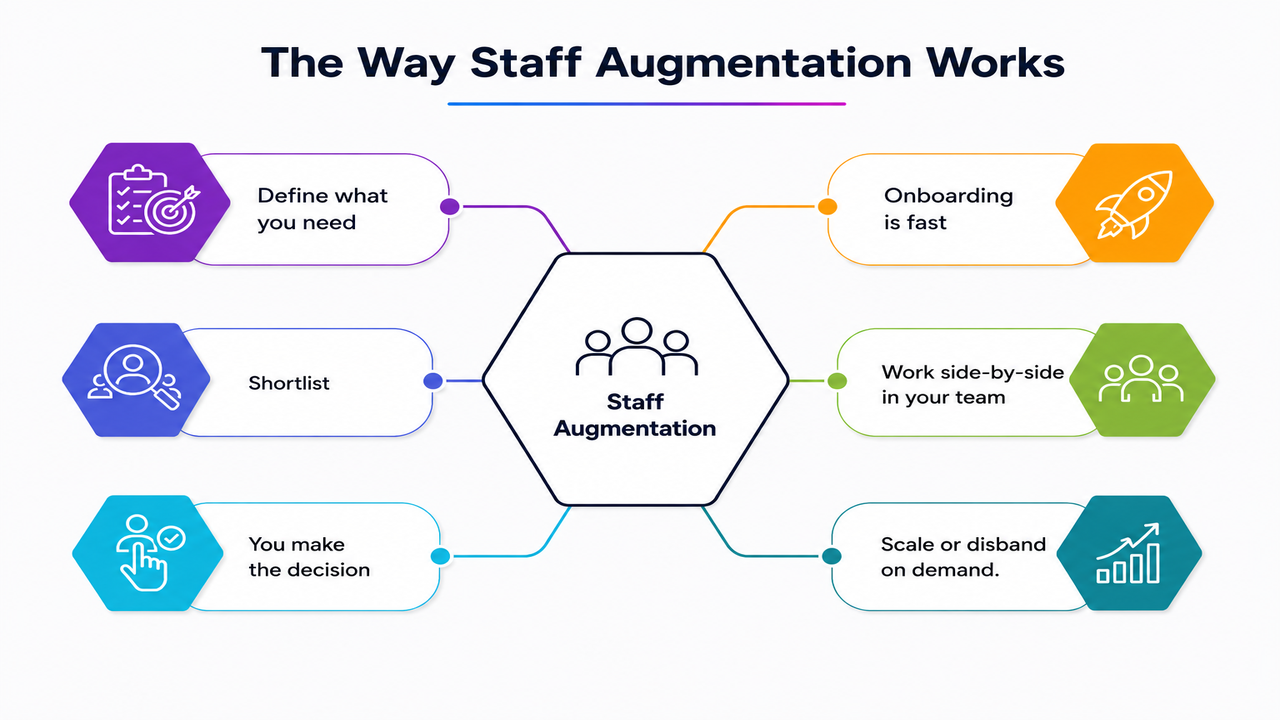
The process is simpler than most people expect. Here's how a typical engagement runs from start to delivery:
Step 1: Define what you need
You communicate your augmentation requirements, including the competencies, technology stack, engagement time frame, and the way the augmented resource is going to fit into your team. The clearer you are at this point, the quicker the matching process.
Step 2: Shortlist
A professional service provider sends you qualified candidate profiles within 24 to 72 hours. It's not a stack of CVs – pre-screened engineers, whose technical skills correspond with the work you need done, and who were evaluated during the selection process.
Step 3: You make the decision
You conduct interviews and select the right candidates to continue with. You decided to hire; you are not expected to follow someone else's advice.
Step 4: Onboarding is fast
The candidate you chose will be onboarded and start working on your project within three to five days from now. Access to the toolchain, signing NDAs, and aligning sprints is organized by the provider for you.
Step 5: Work side-by-side in your team
Starting on the first day of engagement, the augmented engineer works in your daily stand-ups, grabs tasks from your backlog, commits code, and passes reviews just like your permanent employees. You distribute tasks; they perform them.
Step 6: Scale or disband on demand.
When the engagement finishes, when your goals are fulfilled, you have options: extend it, scale it up to a team of engineers, or simply end it without causing any issues typical for internal reorganization.
Staff Augmentation vs. Outsourcing vs. Freelancers
These three models often get mentioned in the same breath, but they solve different problems. Getting the distinction wrong costs you time, money, and control.
Factor | Staff Augmentation | Project Outsourcing | Freelancers |
What it is | External professionals embedded into your existing team | A defined deliverable handed off to an external team | Independently hired individuals via platforms like Upwork or Toptal |
Who controls the work? | You, entirely | The vendor | You (loosely) |
Who manages the person? | You, daily direction, tasks, reviews | The vendor owns the process | You, with minimal structure |
Where does work happen? | Inside your sprints, your tools, your workflow | Inside the vendor's process | Independently, on their own schedule |
Vetting & reliability | High, screened, and committed | Varies by agency | Varies widely |
Typical commitment | Weeks to months, ongoing | Project-scoped | Hours to weeks |
Best for | Adding capacity or a specific skill when your infrastructure is already in place | Full delivery handoff when you lack internal engineering leadership | Small, isolated, one-off tasks with no sprint dependency |
Risk if it goes wrong | Manageable, you catch it early because you're at work daily | High, you may only see problems at delivery | Medium, easy to swap out, but can disrupt timelines |
Simple rule: if your team has the structure to direct people but not enough people to do the work, staff augmentation is the right model.
Situations Where Staff Augmentation Works Best
Here are the five situations where bringing in augmented staff is the right call.
1. Your backlog is outpacing your team's capacity
Sprint velocity has plateaued. Your engineers are stretched. Features that should take two weeks are taking five. The team isn't slow; they're just full. Augmenting adds capacity without asking anyone to work harder.
2. Full-time hiring is taking too long
Approvals are stalled. The recruiter's shortlist isn't landing. Ideal candidates aren't applying. Meanwhile, your product timeline keeps moving. Augmentation gets you a contributing developer in days, while the permanent hire search continues in the background.
3. You need a specific skill for a defined sprint
You need a QA engineer for a six-week release cycle. Or a DevOps engineer for a cloud migration that runs through Q3. Hiring a full-time specialist for a three-month need doesn't make economic sense. Augmentation is built for exactly this situation.
4. Your launch deadline is fixed, and your headcount isn't
Demo day, investor review, product launch- the date is locked. The team size is not. Rather than risking the timeline, you bring in the people you need for the sprint and scale back when it's done.
5. You want to trial talent before committing
A 30-day or 2-week paid trial sprint lets you see output quality, communication style, and team fit in real conditions before you decide on a longer engagement or explore a permanent hire. It's one of the most practical risk-reduction tools available to engineering teams.
The Real Impact of Staff Augmentation on Your Team
The benefits aren't abstract. They show up in specific, measurable ways.
Speed. Average time for full-time tech hiring varies between three and four months from post to first commit. In the case of staff augmentation, you get a shortlist of candidates in 24 to 48 hours, and someone starts working within a week. It is not just a slight difference but an entirely different level of speed.
Cost predictability. No salaries, no benefits package, no provision funds, no gratuity, no notice period compensation. You will pay for engagement only. The cost is simple and clear; it is tied directly to your project needs and performance. Cost predictability is essential for early-stage startups and growth companies to keep track of their burn rate.
Flexibility. You may start with a single developer and end up with a five-member pod if the roadmap requires it. Once the sprint finishes, the engagement also ends, so there will be no restructuring and uncomfortable conversations. Excess capacity will not happen.
Retained control. Compared to outsourcing, you do not give up control over the workflow. Augmented developers will work according to your processes, your standups, reviews, etc.
Lower hiring risk. You identify problems with skills and quality in two weeks instead of finding out that the hire does not work after six months. In the case of failed hiring, an experienced vendor will seamlessly switch resources for you.
Factors Behind a Successful Staff Augmentation Engagement
The model works, but only when both sides are set up for it. Most failed engagements can be traced back to missing infrastructure, not missing talent.
What your team needs in place
Before augmenting, make sure you have:
An internal owner, a PM, or an Engineering Manager who can give daily direction, review output, and provide feedback. Augmented staff need someone to report to. If that person doesn't exist, the engagement drifts.
A defined backlog, sprint-ready tickets with acceptance criteria, not a list of vague goals. Augmented resources can't create the backlog for you; they need it to be ready to work from.
A working toolchain, Jira or Linear, GitHub, Slack, and a CI/CD pipeline. If these aren't in place, onboarding takes weeks instead of days.
Clear communication norms: When are standups? How is code reviewed? What does "done" look like? The sooner this is established, the faster the augmented resource becomes productive.
What to expect from a quality provider
A provider worth working with will deliver:
Profile screening within 24 to 48 hours of receiving your requirements.
A replacement guarantee if the first match isn't right, without making you start over.
Weekly reporting: output metrics, not just hours logged
Clean onboarding: NDAs, access provisioning, and sprint alignment are handled on their side, so you don't have to manage it
How Netizens structures its Team Extension Program
Staff augmentation at Netizens Technologies is not only a service but a comprehensive program designed around the real work processes of engineering teams.
Netizens Technologies provides you with a 2-week trial period, during which you can assess the quality of work, the interaction process, and overall fit before agreeing to a long-term collaboration. Subsequent engagements start from a minimum period of three months. Staff roles include frontend and backend development, full-stack engineering, QA engineering, DevOps, UI/UX design, and AI engineering.
The world changes, and your team needs to change with it. It all moves with your product, not against it.
Frequently Asked Questions
1. How quickly can you add a developer to my team?
You receive a shortlist of vetted profiles within 24 to 48 hours of submitting your requirements. Once you select a candidate, onboarding typically takes three to five business days.
2. What is the minimum engagement length?
Trial sprints start at 2 weeks.
3. Do I manage the developer directly?
Yes. You assign tasks, run standups, and review output. The provider handles compensation, contracts, and admin. You lead the work.
4. What happens if the developer isn't the right fit?
A quality provider offers a replacement guarantee. At Netizens, if a resource isn't working for your team, we replace it within an agreed SLA at no additional cost.
5. What roles can be augmented?
Frontend, backend, and full-stack developers; QA engineers (manual and automated); DevOps and cloud engineers; UX/UI designers; and AI/ML engineers. Single resources or pods of 2 to 5.
Designed to Support Your Team
If your work is piling up faster than your team can handle, or you can’t hire in time for an upcoming deadline, staff augmentation is worth considering.
Tell us your stack and your backlog situation. We'll put together the right team configuration and get you profiles. Start a 2-week Team Extension Trial. Netizens Technologies builds and supports custom software with a design-led engineering team. Our Team Extension Program gives you skilled developers, QA engineers, DevOps specialists, and designers who plug into your sprints, with a long-term commitment.
Your Product Could Be the
Next Case Study
Explore what we’ve built — and let’s collaborate to create something impactful for your business.
We reply within 24 business hours.