How to Onboard an External Development Team Without Losing Velocity

TL;DR / Summary
Learn how to onboard external development teams fast. Protect your sprint velocity, cut onboarding friction, and start shipping code in days.
Table of Contents
- Traditional Onboarding vs Structured Onboarding
- Why Does External Onboarding Usually Drag Down Sprint Velocity?
- Step 1: Prep Technical Access 48 Hours Before Day One
- Step 2: Use the 30-Minute Local Setup Rule
- Step 3: Assign a Starter Task for Sprint One
- Step 4: Set Up Asynchronous Communication Channels
- Step 5: Establish Clear Code Review Standards
- Step 6: Define Success Metrics for the First 30 Days
- Key Takeaways
- FAQs
- 1. How long should it take for an external developer to ship their first code?
- 2. How do I prevent internal developers from burning out during onboarding?
- 3. Should external developers join daily standup meetings?
- 4. What is the biggest mistake companies make when onboarding external teams?
- 5. How do I handle code quality concerns with augmented dev teams?
- 6. What documentation is required before an external team starts?
- 7. How do I maintain security when giving external teams codebase access?
- Conclusion
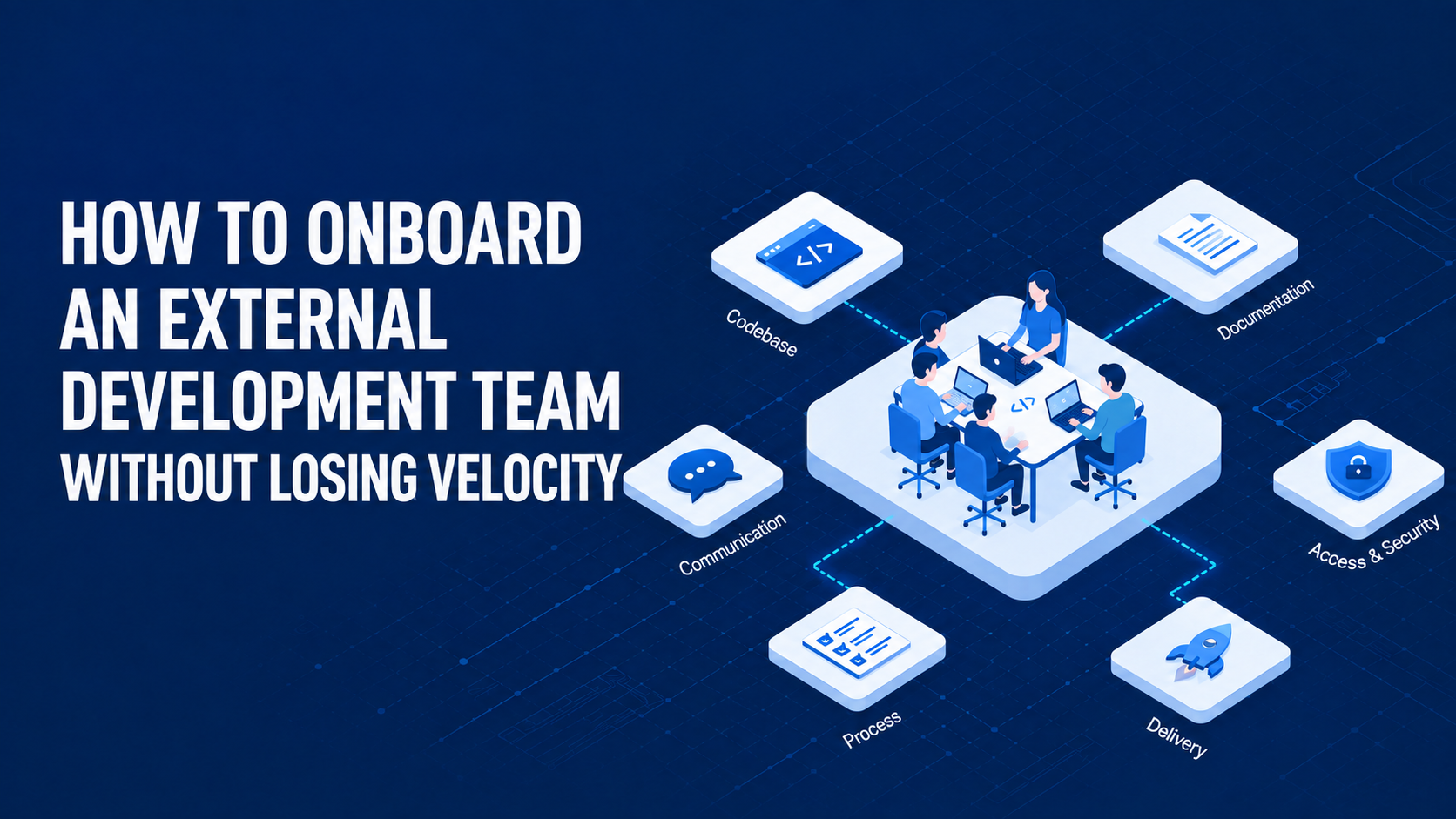
Hiring an external development team should help you ship faster. But for many engineering teams, the first few weeks feel slower than before. Senior developers spend more time answering questions than writing code, sprint goals slip, and everyone starts wondering whether bringing in outside help was the right decision.
The good news is that the external team itself doesn't cause this. It's usually the result of an unstructured onboarding process. With the right preparation, external developers can contribute meaningful code within their first few days.
In this guide, we'll walk through a practical onboarding framework that helps engineering teams integrate external developers without disrupting delivery.
Traditional Onboarding vs Structured Onboarding
Traditional Onboarding | Structured Onboarding |
Access requested on Day 1 | Access ready before Day 1 |
Multiple setup meetings | Clear documentation and checklists |
First PR after 1–2 weeks | First PR within 2–3 days |
Frequent interruptions for senior developers | Asynchronous support and recorded walkthroughs |
Productivity drops during onboarding | Sprint velocity remains stable |
Why Does External Onboarding Usually Drag Down Sprint Velocity?
Adding new developers to an existing team often creates an immediate drop in speed. Engineering leaders expect extra capacity right away. Instead, senior in-house developers spend half their week answering setup questions, giving permissions, and explaining code layout.
This slowdown occurs because most companies treat external onboarding as if it were hiring a permanent employee. They schedule days of HR overviews, full architecture deep dives, and broad team introductions. External developers do not need full company history to fix backlog items. They need repo access, clear task specs, and a working local environment.
When context sharing relies on live meetings instead of written docs, internal engineers lose focus. A single interruption can cost a senior developer two hours of deep work. When four new engineers ask questions throughout the day, internal delivery grinds to a halt.
Step 1: Prep Technical Access 48 Hours Before Day One
Nothing kills momentum faster than an external engineer waiting three days for a Git login. Set up all accounts, tool access, and permissions before the developer logs in for their first standup.
Create an access checklist for every external role. Grant least-privilege access to the specific tools required to complete the first sprint.
GitHub or GitLab repository access with correct branch permissions
Jira, Linear, or Trello board access with tagged onboarding tickets
Slack, Microsoft Teams, or Discord channels for immediate daily communication
Staging environment credentials and sandbox API keys
Password management access for shared service credentials
Tool | Purpose |
GitHub | Repository access |
Jira | Sprint management |
Slack | Communication |
Docker | Local setup |
Staging Environment | Safe testing |
Password Manager | Secure credentials |
Step 2: Use the 30-Minute Local Setup Rule
If an external developer cannot spin up your app locally in under 30 minutes, your environment setup is broken. Long, manual setup guides lead to constant questions and setup errors.
Automate local environment setups using Docker containers, setup scripts, or seed data files. Test your setup guide on a clean machine every quarter.
Maintain a single README file in the main repository root.
Document every environment variable in an example file with dummy values.
Provide a simple seed database script so developers test with realistic data.
List exact version numbers for runtimes, databases, and dependencies.
We've seen engineering teams spend nearly an entire sprint helping new developers resolve local environment issues. In many cases, a few hours spent improving setup documentation eliminates dozens of repetitive support requests later. .
Step 3: Assign a Starter Task for Sprint One
Do not give new developers a complex feature build on their first day. Complex tasks require deep domain knowledge that new engineers do not have yet.
Assign a small, self-contained ticket that touches the main deployment pipeline. Fixing a minor bug or writing a simple unit test forces the engineer to pull code, run tests, and push a pull request.
Choose a task with clear acceptance criteria and no external dependencies.
Select tickets that require running the full CI/CD deployment pipeline.
Keep the scope small enough to complete and review within 48 hours.
Use the first code review to align on coding standards and style rules.
Example:
Imagine you're building a SaaS platform. Instead of assigning a payment gateway integration on day one, ask the new developer to fix a UI issue or improve an API endpoint. This lets them understand your workflow without risking a critical feature.
Shipping working code to staging in the first 48 hours builds immediate confidence. It proves the developer has working access, understands the workflow, and can push changes safely.
Step 4: Set Up Asynchronous Communication Channels
Constant direct messages destroy engineering focus. When external developers message senior leads for every small blocker, team output plummets.
Create structured channels for questions and documentation. Require external developers to search existing logs and documentation before asking for help.
Dedicated Slack channel for onboarding questions where any team member can answer
Documented escalation path when an engineer is blocked for more than 30 minutes
Asynchronous daily standups using written updates in Slack or Jira
Mandatory recording of all architecture overviews for future team members

Step 5: Establish Clear Code Review Standards
Code reviews often turn into bottlenecks when external teams join. Without explicit guidelines, internal reviewers waste time arguing over code formatting, naming conventions, and minor style preferences.
Automate linting and formatting rules using pre-commit hooks and automated CI checks. Let your automated pipeline catch style errors so human reviewers focus on logic, security, and performance.
Review Area | Automated Check | Human Review Focus |
Code Formatting | Prettier, ESLint, Black | Clear variable naming and readability |
Test Coverage | Jest, PyTest, Codecov | Edge cases and business logic coverage |
Security | Snyk, Dependabot | Authentication, data exposure, leak risks |
Performance | Lighthouse, APM tools | Query efficiency, memory usage, limits |
Step 6: Define Success Metrics for the First 30 Days
Tracking time logged does not tell you if an external developer is succeeding. Measure concrete delivery metrics to assess integration speed and code quality.
Track metrics that reflect real output and integration health rather than raw hours worked.
Time to first pull request merged (Target: under 3 days)
Deployment frequency per developer per week (Target: 3+ deployments)
Pull request revision rate (Target: under 2 iterations per PR)
Onboarding satisfaction score from internal team leads
Most software leaders judge external teams on raw velocity too early. Focus on integration quality and PR cycle time during the first month, and raw speed will naturally follow.
Key Takeaways
Grant all tool, repo, and environment access 48 hours before day one.
Keep local environment setup time under 30 minutes with scripts and Docker.
Assign a small starter ticket in sprint one to test the full CI/CD pipeline fast.
Automate code style checks to prevent review bottlenecks on human engineers.
Measure PR cycle time and deployment speed instead of hours logged.
FAQs
1. How long should it take for an external developer to ship their first code?
An external developer should ship their first pull request to a staging environment within 48 to 72 hours. Assigning a small bug fix or minor task during sprint one verifies access rights and tests the CI/CD pipeline quickly.
2. How do I prevent internal developers from burning out during onboarding?
Protect internal developers by documenting setup steps and automating linting checks. Set up a shared Slack channel for questions so one senior engineer does not carry the entire burden of answering messages.
3. Should external developers join daily standup meetings?
Yes, external developers should participate in daily standups to maintain alignment. If your team works across different time zones, use asynchronous written standups in Slack or Linear to share daily progress without scheduling conflicts.
4. What is the biggest mistake companies make when onboarding external teams?
The biggest mistake is treating external developers like permanent hires who need weeks of company context before writing code. External engineers perform best when given clear specs, working repo access, and immediate coding tasks.
5. How do I handle code quality concerns with augmented dev teams?
Set up automated linting, type-checking, and test coverage gates in your CI/CD pipeline. Require all external code to pass automated checks and receive an internal peer review before merging into main branches.
6. What documentation is required before an external team starts?
You need an updated README file, an environment configuration guide with sample keys, clear pull request guidelines, and an architecture overview. Keep docs concise so developers read them quickly.
7. How do I maintain security when giving external teams codebase access?
Use role-based access control and grant least-privilege permissions. Provide sandbox credentials for development, store secrets in password managers, and never share production environment access with external contractors.
Conclusion
Successfully onboarding an external development team isn't about adding more meetings or lengthy documentation. It's about giving developers the right access, clear expectations, and a structured process from day one. When external engineers can quickly set up their environment, understand your workflow, and contribute meaningful code within the first few days, your internal team stays focused, and your sprint velocity remains on track.
Whether you're scaling to meet growing product demands or extending your engineering capacity for a specific project, a well-planned onboarding process can make the difference between a smooth transition and weeks of lost productivity. If you're looking for experienced development teams that integrate seamlessly into your existing workflows, Netizens Technologies will help you scale faster without disrupting delivery.

Your Product Could Be the
Next Case Study
Explore what we’ve built — and let’s collaborate to create something impactful for your business.
We reply within 24 business hours.