How to Evaluate a Software Development Company: 8 Questions to Ask Before You Sign

TL;DR / Summary
Vetting a software dev agency? Skip glossy portfolios and ask these 8 structural questions about delivery, IP rights, and code quality before signing.
Table of Contents
- What Should You Check Before Hiring a Software Development Company?
- How Can You Evaluate a Software Company Beyond Its Portfolio?
- What Makes a Good Software Development Company?
- Question 1: Who Will Actually Write the Code, and What Is the Seniority Ratio?
- Question 2: How Do You Enforce Code Quality and Prevent Technical Debt?
- Question 3: What Is Your Code Ownership and IP Protection Model?
- Question 4: How Do You Handle Scope Changes, Estimates, and Budget Overruns?
- Question 5: What Does Your Daily and Weekly Communication Workflow Look Like?
- Question 6: Can We Start With a Risk-Free Trial or Pilot Sprint?
- Question 7: How Do You Handle Security, Compliance, and Data Protection?
- Question 8: What Happens After Launch? What Are Your SLA and Support Terms?
- Key Takeaways
- FAQs
- 1. What is the most important factor when evaluating a software development company?
- 2. Should I choose a fixed-price or time-and-materials contract for custom software?
- 3. How can I test a software agency before signing a major contract?
- 4. What red flags should I watch for when vetting a dev agency?
- Conclusion: Vetting Is About Risk Mitigation, Not Promises
To evaluate a software development company effectively, look beyond polished portfolios and client logos. A strong development partner should be able to clearly explain who will build your product, how they maintain code quality, who owns the code, how they handle changes, and what support you receive after launch.
The right questions can help you identify delivery risks before they turn into missed deadlines, unexpected costs, or a codebase your team cannot maintain.
In our experience working with software teams, the most difficult projects are not always the largest ones. Projects often become difficult when ownership is unclear, requirements keep changing, communication breaks down, or the team working on the product changes halfway through development. That is why evaluating a development partner requires looking beyond their portfolio. You need to understand how they actually work.
Asking targeted structural questions about sprint handoffs and scope management exposes potential delivery risks before you commit capital to an agency contract.
What Should You Check Before Hiring a Software Development Company?
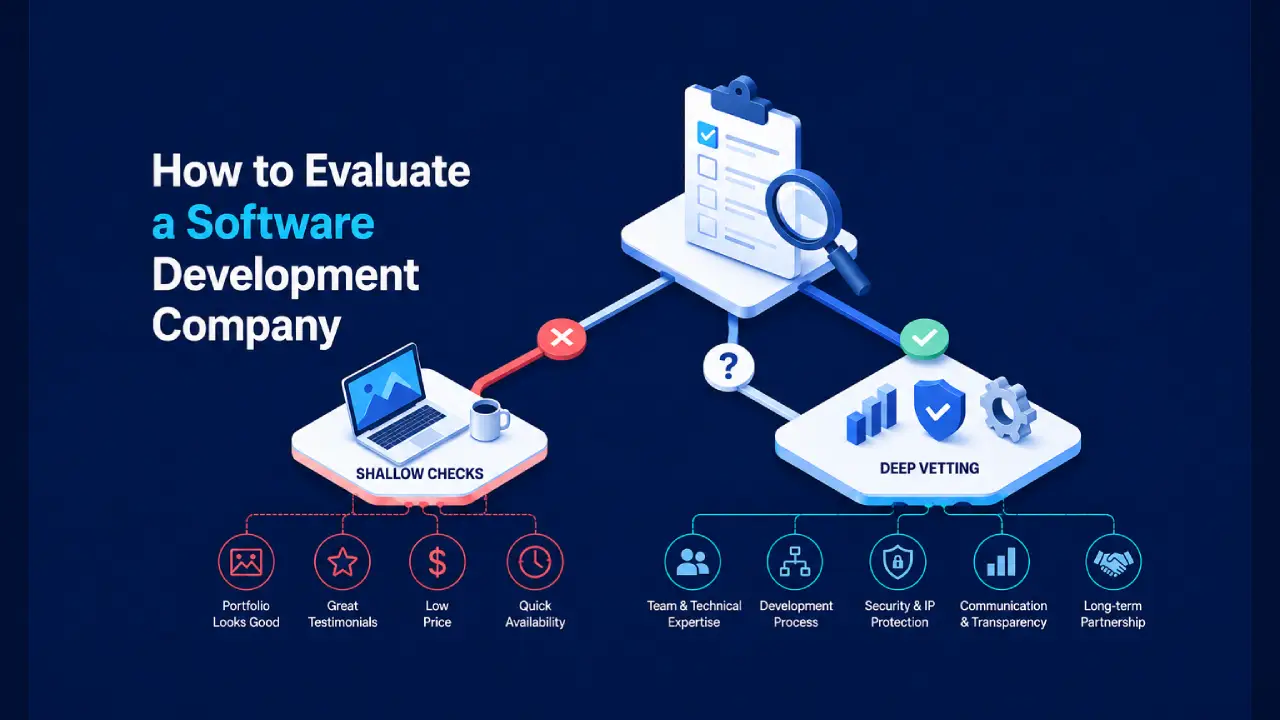
Before signing a contract, evaluate the company across these eight areas:
The actual development team - Who will work on your project?
Code quality - How are code reviews and testing handled?
IP ownership - Who owns the source code and project assets?
Scope and budget control - How are changes and extra costs handled?
Communication - How will you communicate and track progress?
Trial options - Can you test the team before committing long-term?
Security - How does the company protect your data and application?
Post-launch support - What happens after your software goes live?
How Can You Evaluate a Software Company Beyond Its Portfolio?
Evaluating a software development company requires probing their actual engineering practices rather than reviewing curated marketing case studies. Most agencies showcase pristine user interfaces, but slick designs often mask fragile architectures, unmaintainable code, or manual deployment processes that cause technical debt later.
To reveal how a vendor operates under real project constraints, structure your evaluation around technical rigor, operational clarity, and contract protections.
What Makes a Good Software Development Company?
A good software development company combines technical expertise with clear communication and reliable delivery processes. It should have a qualified team, a transparent development process, strong code ownership terms, clear pricing, appropriate security practices, and post-launch support.
The best partner is not necessarily the company with the biggest portfolio. It is the company that can clearly explain how your project will be built, who will build it, how quality will be checked, and what happens if requirements change.
Question 1: Who Will Actually Write the Code, and What Is the Seniority Ratio?
Inquire directly about the specific engineers assigned to your team, their experience levels, and how the agency handles staff allocation. Many agencies use senior architects to pitch during sales calls, then quietly assign the core build to junior developers once the contract is executed.
Ask for the developer profiles or interview the exact team members who will touch your repository.
🟢 GREEN FLAG: Look for a clear team matrix showing senior, mid-level, and lead engineers. You should know who will actually work on your project before development begins.
🔴 RED FLAG: Be cautious if an agency cannot tell you exactly who will work on your repository or only gives vague assurances about its available talent.
The team introduced during the sales process can have a major impact on the project experience. A strong proposal can look impressive, but the people who actually write the code, make technical decisions, and communicate with your team are the people who determine the project's outcome. That is why we believe clients should know who will work on their product before development begins.
#NetizensPOV: Most engineering leaders discover too late that a vendor's "senior developer" is actually a mid-level engineer backed by AI prompts without deep systems-architecture experience.
Question 2: How Do You Enforce Code Quality and Prevent Technical Debt?
Demand a specific breakdown of their code review processes, automated testing protocols, and static analysis tools. Technical debt, the accumulated cost of choosing quick, unrefined code shortcuts over scalable architecture, is the single largest hidden expense in outsourced software development.
A reliable development partner enforces mandatory pull request (PR) reviews, automated CI/CD (continuous integration and continuous deployment, the automated pipeline that builds, tests, and deploys code updates) pipelines, and minimum test coverage thresholds before any branch merges into production.
🟢 GREEN FLAG: Mandatory code reviews, automated testing, CI/CD, static analysis, and documentation.
🔴 RED FLAG: Developers merge their own code, testing happens only before release, and no technical documentation exists.
Assessment Area | High-Rigor Vendor | Low-Rigor Vendor |
Code Reviews | Dual-peer review required for every PR | Solo developer merges directly to main |
Automated Testing | Unit, integration, and end-to-end tests in CI pipeline | Manual QA performed right before release |
Static Analysis | Automated linters and vulnerability scanners | No static analysis or security linting |
Documentation | Self-documenting code + inline specs + architecture docs | No technical documentation provided |
Question 3: What Is Your Code Ownership and IP Protection Model?
Confirm in writing that your company retains full, unencumbered ownership of all intellectual property (IP), source code, design assets, and credentials from day one. You must ensure there are no legal loopholes or proprietary agency frameworks that restrict your ability to bring development in-house later.
Ensure the contract explicitly states that all work created under the agreement is a "work made for hire." Additionally, verify that all third-party open-source licenses used in your project are commercially permissive (e.g., MIT, Apache 2.0) rather than copyleft licenses (e.g., GPL) that could compromise your proprietary code base.
🟢 GREEN FLAG: Your company owns the source code, IP, design assets, credentials, and project deliverables in writing.
🔴 RED FLAG: Unclear ownership terms, proprietary agency lock-in, or unclear third-party licensing.
Question 4: How Do You Handle Scope Changes, Estimates, and Budget Overruns?
Ask the agency to explain their methodology for estimating tasks and handling scope drift during active sprints. Fixed-price contracts often encourage vendors to cut corners on code quality when estimates run over, while unconstrained Time & Materials (T&M) contracts can lead to budget inflation without accountability.
Look for teams that operate on a hybrid or iterative sprint model with clear change-order protocols. They should use burn-down charts, velocity tracking in tools like Jira or Linear, and weekly demo milestones so budget deviations are identified in days rather than months.
🟢 GREEN FLAG: Clear estimates, sprint tracking, change-order rules, and regular budget reviews.
🔴 RED FLAG: Uncontrolled scope changes, unclear estimates, and unexpected invoices.
#NetizensPOV: If an agency cannot demonstrate their automated CI/CD pipeline and deployment triggers during the sales evaluation, you will inevitably pay hourly rates for manual deployment errors down the road.
Question 5: What Does Your Daily and Weekly Communication Workflow Look Like?
Evaluate the vendor's operational transparency, tool stack, and response expectations. Distance or timezone differences matter far less than communication discipline and shared project visibility.
A modern software partner integrates directly into your workflow rather than sending periodic email updates.
Direct Slack/Teams access: You can message engineers or the product manager directly.
Asynchronous updates: Daily standup notes posted in dedicated project channels.
Working software demos: Live, functional product walk-throughs at the end of every 1- or 2-week sprint.
Transparent repositories: Full visibility into Git commits, PRs, and task boards.
🟢 GREEN FLAG: Direct communication, shared project tools, regular demos, and repository visibility.
🔴 RED FLAG: Occasional email updates, delayed responses, and no visibility into the actual work.
Question 6: Can We Start With a Risk-Free Trial or Pilot Sprint?
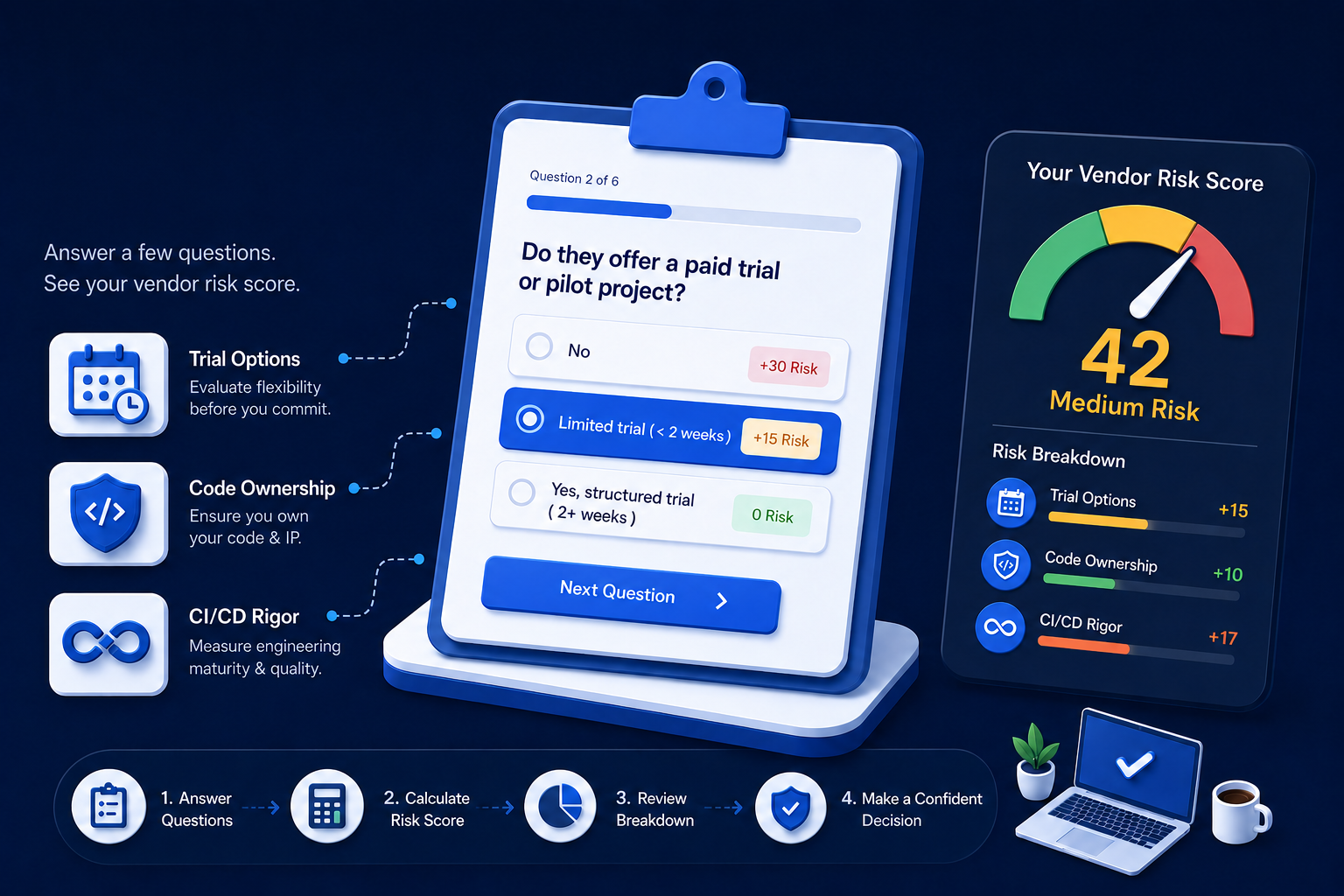
Ask if the development company offers a short trial period, proof-of-concept sprint, or an initial 2-week to 30-day trial engagement before you commit to a long-term contract. A trial period tests real-world velocity, communication, and engineering quality without locking your organization into a multi-month commitment.
A confident software vendor will welcome a pilot project, such as building a discrete feature or refactoring a subsystem, to prove their delivery capacity before scaling the engagement.
🟢 GREEN FLAG: The agency is willing to prove its work through a short pilot or trial sprint.
🔴 RED FLAG: The agency demands a long-term commitment before you can evaluate its team or work
We have found that a short trial can reveal things that sales conversations cannot. You can see how quickly the team understands your requirements, how clearly they communicate, how they handle feedback, and whether the quality of the work matches expectations. For companies that are unsure about committing to a long-term development partner, a trial sprint can be a practical way to reduce that risk.
Question 7: How Do You Handle Security, Compliance, and Data Protection?
Inquire about the vendor’s security protocols, data handling policies, and compliance standards (such as SOC 2, GDPR, or HIPAA where applicable). Security breaches often originate from misconfigured cloud infrastructure or hardcoded environment variables during development.
Request details on how they store API keys, manage database access, conduct vulnerability scans, and perform penetration testing. Ensure their developers follow OWASP (Open Worldwide Application Security Project) guidelines to protect against common web application vulnerabilities like SQL injection and cross-site scripting (XSS).
🟢 GREEN FLAG: Secure credential management, controlled access, vulnerability testing, and clear data protection practices.
🔴 RED FLAG: Hardcoded API keys, unrestricted access, unclear security policies, or no vulnerability testing.
Question 8: What Happens After Launch? What Are Your SLA and Support Terms?
Clarify post-launch maintenance, bug-fix guarantees, and service level agreements (SLAs). Software builds do not end at initial launch; they require ongoing infrastructure updates, dependency patches, and operational support.
Review the agency's post-launch warranty window (typically 30 to 90 days for critical bug fixes) and ask about SLA-backed retainer options for ongoing maintenance. Ensure clear response time thresholds for critical outages versus non-urgent feature requests.
🟢 GREEN FLAG: Written warranty terms, clear SLAs, response times, and ongoing maintenance options.
🔴 RED FLAG: No defined support period, unclear response times, or “we can discuss support after launch.”
Key Takeaways
Evaluate real technical practices: Look beyond portfolio screenshots to inspect CI/CD automation, code review policies, and testing coverage.
Secure absolute IP rights: Ensure all source code, architecture, and credentials are contractually assigned as work-for-hire from day one.
Demand direct access: Partner with agencies that grant direct access to engineers via Git repositories and real-time messaging platforms.
De-risk with a trial: Validate vendor velocity and code quality through a 2-week trial or pilot sprint before signing long-term retainer agreements.
Lock down post-launch support: Establish clear SLA windows and bug-fix warranties before deploying code to production.
FAQs
1. What is the most important factor when evaluating a software development company?
Technical transparency and delivery rigor are the most critical factors. Ensure you have direct access to the team, full code ownership, clear CI/CD testing pipelines, and visibility into their Git repository during development.
2. Should I choose a fixed-price or time-and-materials contract for custom software?
Fixed-price contracts work best for small, rigidly defined projects with zero expected changes. For complex custom software, an iterative Time & Materials or dedicated team model with sprint milestones prevents vendors from cutting corners when requirements evolve.
3. How can I test a software agency before signing a major contract?
Request a paid pilot project or a 2-week trial sprint focused on a specific feature, refactoring task, or architectural audit. This tests their real-world code quality, communication, and velocity with minimal financial risk.
4. What red flags should I watch for when vetting a dev agency?
Key red flags include reluctance to grant early Git repository access, unvetted offshore subcontracting, lack of automated testing, unclear IP ownership language, and refusal to provide direct access to developers.
Conclusion: Vetting Is About Risk Mitigation, Not Promises
Signing a software agency isn’t just a procurement decision - it’s an operational commitment. Glowing case studies and slick sales decks demonstrate marketing capability, but they reveal nothing about how a team handles technical debt, pipeline failures, or evolving scope.
By asking structural questions early, you accomplish three critical things:
Uncover hidden risks before committing capital.
Establish operational standards around code quality, testing, and CI/CD.
Protect your business with clear IP ownership and post-launch SLAs.
If a potential vendor hesitates to show you live Git activity, clarify their seniority matrix, or agree to a short pilot sprint, take note. A truly reliable engineering partner won't just welcome your scrutiny - they'll expect it.
Your Product Could Be the
Next Case Study
Explore what we’ve built — and let’s collaborate to create something impactful for your business.
We reply within 24 business hours.