What Growth-Stage Businesses Get Wrong About Technology Partnerships

TL;DR / Summary
Growth-stage companies often choose software vendors based on rates and end up with delays and tech debt. Learn how to choose the right technology partner.
Table of Contents
- What Does a Technology Partnership Really Mean for a Growing Business?
- Does Adding External Developers Automatically Increase Engineering Capacity?
- The Myth
- The Reality
- Lowest Hourly Rates Deliver the Lowest Overall Project Cost
- The Myth
- The Reality
- You Should Outsource Everything or Keep Everything In-House
- The Myth
- The Reality
- What Should Stay In-House?
- What Can External Partners Handle?
- How Growth-Stage Businesses Should Evaluate Technology Partners
- How Can Growth-Stage Businesses Build a Successful Technology Partnership?
- Step 1: Test the Partnership Before Scaling It
- Step 2: Establish Single-Point Ownership
- Step 3: Integrate External Engineers Into Your Workflows
- Step 4: Measure Performance With Meaningful Metrics
- Key Takeaways
- Frequently Asked Questions
- 1. What is the difference between software outsourcing and a technology partnership?
- 2. How quickly can a technology partner integrate with an existing team?
- 3. What delivery model works best for growth-stage software projects?
- 4. How do we prevent vendor lock-in when working with an external partner?
- 5. Should startups use staff augmentation or full product development teams?
- 6. How do we ensure security when sharing code with an external partner?
- Conclusion
As businesses grow, their technology needs become more complex. Product backlogs increase, internal engineering teams get stretched, and technical decisions start affecting how quickly the business can scale.
That’s when many growth-stage companies turn to external technology partners. But a common mistake is treating these partners like traditional software vendors, comparing hourly rates, assigning tickets, and measuring success by completed tasks.
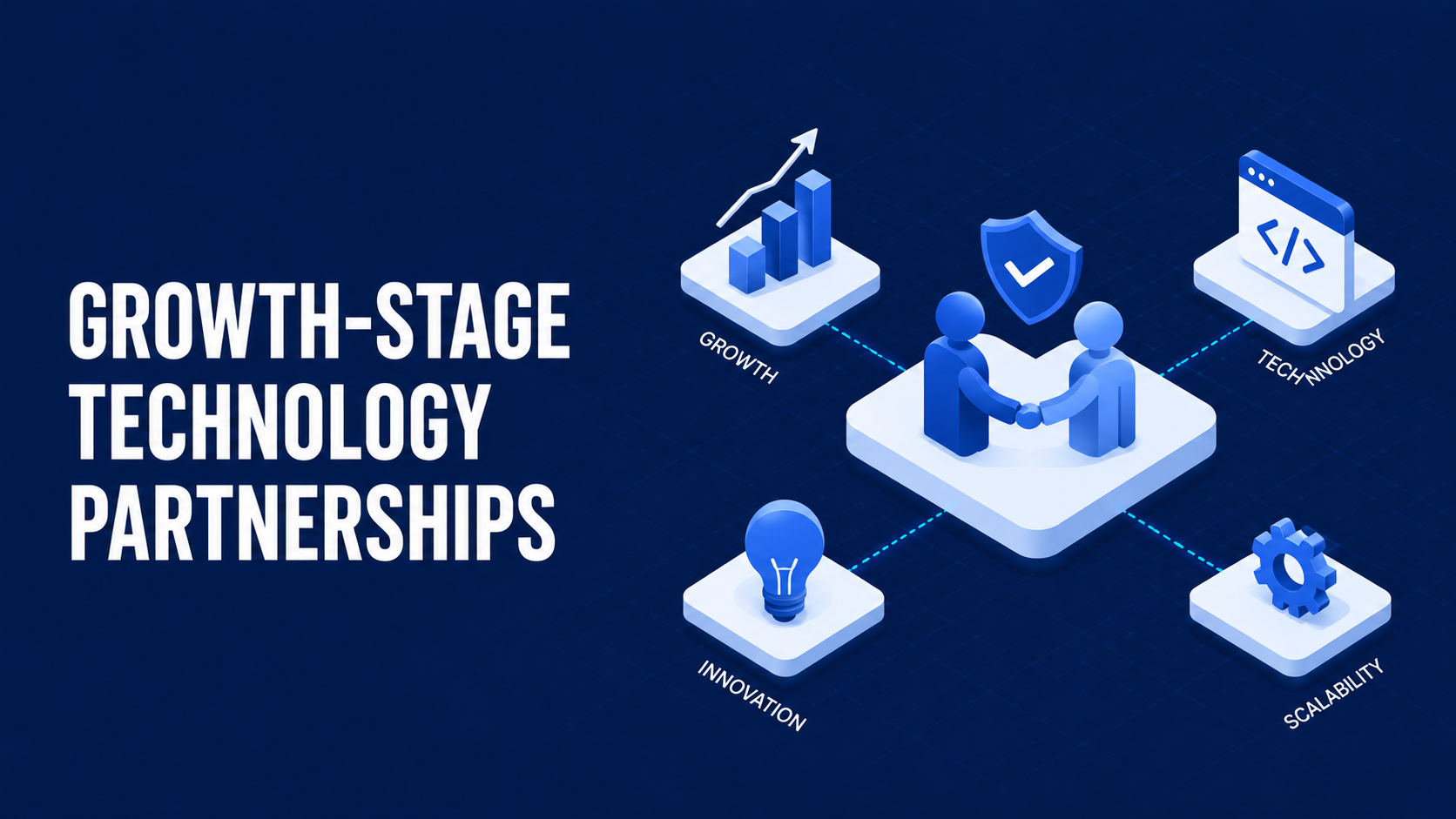
A true technology partnership is different. It focuses on shared technical ownership, delivery outcomes, and long-term product growth, not simply adding more developer hours.
What Does a Technology Partnership Really Mean for a Growing Business?
A technology partnership is an integrated working relationship where an external engineering team works alongside your internal team to support software delivery, product development, and long-term technical goals.
Unlike a traditional software vendor, a technology partner doesn't simply receive a list of tasks and return completed tickets. The team works within your development processes, understands your product goals, and takes responsibility for delivering reliable software.
Growing companies usually start looking for external engineering support when internal teams reach capacity limits. Feature backlogs grow, customer demands increase, and important technical work gets pushed further down the roadmap.
Many leadership teams assume that adding more developers automatically solves the problem. But engineering capacity isn't simply a headcount number.
Without clear ownership, development processes, testing standards, and communication workflows, additional developers can create more coordination work for the internal team.
Does Adding External Developers Automatically Increase Engineering Capacity?
The Myth
Adding more developers automatically means adding more engineering capacity.
The Reality
Developer headcount and productive engineering capacity aren't the same thing.
If external developers need constant supervision, unclear requirements create rework, or your internal engineers have to review and correct every task, you may gain more developers while losing valuable management time.
A strong technology partner should bring its own delivery discipline, technical leadership, and development processes.
Operating Factor | Transactional Vendor Model | Technology Partner |
Primary Goal | Complete assigned tasks | Achieve product and engineering outcomes |
Team Management | Internal team manages developers | Partner provides delivery ownership |
Communication | Status updates and task handoffs | Integrated communication and planning |
Code Quality | Depends heavily on project oversight | Defined engineering and review standards |
Technical Ownership | Often remains with the client | Shared through designated technical leads |
Long-Term Focus | Complete the contract | Build and improve the product over time |
A good technology partner should fit into your existing engineering workflow rather than creating another layer of management.
That means working with your repositories, documentation, project management tools, code review processes, CI/CD pipelines, and communication channels.
Lowest Hourly Rates Deliver the Lowest Overall Project Cost
The Myth
The cheapest software development team is always the most cost-effective option.
The Reality
Hourly rates only tell you what one hour of development costs. They don't tell you how quickly the team delivers, how much rework is required, or how much time your internal team needs to spend managing the engagement.
For example, consider two developers:
Developer A: $30/hour × 160 hours = $4,800
Developer B: $60/hour × 40 hours = $2,400
The second developer has a higher hourly rate but delivers the work in significantly fewer hours.
A low-cost development engagement can become expensive when it creates:
Rework: Another developer needs to fix or rewrite poorly implemented features.
Technical debt: Quick solutions make future development slower and more expensive. McKinsey research estimates that technical debt can account for about 40% of an IT organization's technology estate.
Delayed launches: Missed deadlines can delay revenue-generating features.
Management overhead: Internal leaders spend more time reviewing, correcting, and coordinating external work.
Production issues: Poor testing or architecture can lead to bugs and reliability problems.
When evaluating technology partners, look beyond hourly rates. Compare delivery quality, engineering experience, communication, technical ownership, and total cost of achieving the desired outcome.
You Should Outsource Everything or Keep Everything In-House
The Myth
A growing company must choose between building a completely internal engineering team and outsourcing its entire product.
The Reality
Growth-stage companies often benefit from a hybrid engineering model.
Your internal team can retain product strategy and critical business decisions while an external engineering partner provides additional development capacity or specialized expertise.
The goal isn't to replace your internal team. It's to extend what your team can accomplish.
What Should Stay In-House?
Your internal leadership should generally retain control over decisions that directly affect the company's long-term direction.
These typically include:
Product Strategy: Deciding what to build and why it matters to customers.
Core Intellectual Property: Protecting proprietary business logic and strategic technology.
Strategic Architecture Decisions: Setting the long-term technical direction of critical systems.
Business Priorities: Determining which features and initiatives receive engineering resources.
Final Product Decisions: Maintaining ownership of the product experience and roadmap.
What Can External Partners Handle?
External engineering teams can provide valuable capacity in areas where your internal team needs additional expertise or execution support.
Integrations
Connecting ERP, CRM, payment, analytics, and third-party systems without pulling your core team away from roadmap priorities.
Workflow Automation
Replacing repetitive manual processes with software workflows, dashboards, integrations, and automation.
Feature Development
Building roadmap features when your internal engineering team doesn't have enough capacity to deliver everything on schedule.
Staff Augmentation
Adding experienced frontend, backend, QA, DevOps, or other specialists when you need specific technical skills.
Performance Engineering
Addressing database bottlenecks, application performance issues, infrastructure problems, and scalability challenges.
Legacy Modernization
Updating older applications, architectures, or development processes that are slowing future product development.
The best model depends on your internal capabilities. A company with strong technical leadership may need additional engineers, while another business may need a partner that can take broader responsibility for product engineering.
How Growth-Stage Businesses Should Evaluate Technology Partners
Evaluating a potential technology partner requires looking past marketing claims. Please inspect how their software teams handle real engineering problems.
When interviewing software agencies, focus your questions on delivery discipline, communication habits, and problem-solving processes.
How Can Growth-Stage Businesses Build a Successful Technology Partnership?
A successful technology partnership doesn't happen simply because you sign a contract. Both teams need a clear operating model from the beginning.
Step 1: Test the Partnership Before Scaling It
Don't commit to a large long-term engagement before understanding how the teams work together.
Start with a focused discovery, technical assessment, pilot project, or delivery sprint.
Use the initial engagement to evaluate how quickly the partner understands your codebase, communicates with your team, handles feedback, and delivers production-ready work.
Step 2: Establish Single-Point Ownership
Assign one internal owner to manage priorities and product decisions for the external team.
The partner should also provide a clear technical lead responsible for engineering quality, delivery, and technical communication.
This prevents developers from receiving conflicting instructions from multiple people.
Step 3: Integrate External Engineers Into Your Workflows
External engineers should not operate in isolation.
Give the team access to the documentation, repositories, communication channels, task boards, and development processes they need to work effectively.
When external engineers understand the broader product context, they can make better technical decisions and identify potential issues earlier.
Step 4: Measure Performance With Meaningful Metrics
Measure outcomes rather than simply tracking developer hours.
Review metrics such as:
Sprint Completion: How consistently agreed work is delivered.
Defect Rate: How many production issues are introduced after releases.
Deployment Frequency: How regularly stable changes reach production.
Lead Time: How long it takes to move work from development to production.
Incident Response: How quickly critical production issues are addressed.
Review these metrics regularly and use them to identify where the partnership can improve.
Key Takeaways
Treat Partners as Engineering Collaborators: A technology partner should contribute to delivery outcomes, not simply complete tickets.
Look Beyond Hourly Rates: The cheapest hourly rate doesn't necessarily produce the lowest total cost.
Use a Hybrid Engineering Model: Keep strategic product decisions in-house while using external teams for additional capacity and specialized expertise.
Evaluate How the Team Works: Look at onboarding, technical ownership, communication, engineering quality, and production support.
Start Small: Test the relationship through a focused engagement before scaling it.
Measure Outcomes: Use delivery and quality metrics rather than hours alone.
Frequently Asked Questions
1. What is the difference between software outsourcing and a technology partnership?
Software outsourcing focuses on specific tasks or projects, while a technology partnership involves shared ownership, integrated teams, and long-term product goals.
2. How quickly can a technology partner integrate with an existing team?
It depends on the product and onboarding process. Clear documentation, access, and communication channels can help the team integrate faster.
3. What delivery model works best for growth-stage software projects?
Sprint-based delivery works well for evolving products, while retainer models are better for ongoing development, maintenance, and support.
4. How do we prevent vendor lock-in when working with an external partner?
Keep ownership of your code, infrastructure, and credentials. Maintain clear documentation and use standard development practices.
5. Should startups use staff augmentation or full product development teams?
Staff augmentation works well when you have technical leadership and need extra skills. Full product teams are better when you need broader engineering ownership.
6. How do we ensure security when sharing code with an external partner?
Use role-based access, secure development practices, confidentiality agreements, and regular access and security reviews.
Conclusion
If your internal team is dealing with growing feature backlogs, technical bottlenecks, or limited engineering capacity, the right external engineering partner can help you increase delivery capacity without adding unnecessary management overhead.
For growth-stage businesses, the goal isn't to outsource everything. It's to find the right balance between internal product ownership and external engineering expertise.
Choose a partner based on delivery quality, technical ownership, communication, and long-term value, not simply hourly rates.

Your Product Could Be the
Next Case Study
Explore what we’ve built — and let’s collaborate to create something impactful for your business.
We reply within 24 business hours.