Custom Web Development Services: Benefits, Process & Cost

TL;DR / Summary
Explore custom web development services, including benefits, UI/UX, development process, costs, integrations, and scalability for growing businesses.
Table of Contents
- What Are Custom Web Development Services?
- Why Do Businesses Choose Custom Web Development?
- What Does Custom Web Development Include?
- How Does the Custom Web Development Process Work?
- 1. Discovery and Requirements
- 2. UI/UX Design and Prototyping
- 3. Development
- 4. Testing and Quality Assurance
- 5. Deployment
- 6. Maintenance and Support
- What Makes UI/UX Important in Custom Web Development?
- How Much Does Custom Web Development Cost?
- When Should You Choose Custom Web Development?
- How Do You Choose the Right Custom Web Development Partner?
- Frequently Asked Questions About Custom Web Development
- 1. What is custom web development?
- 2. How is custom web development different from template-based development?
- 3. How long does custom web development take?
- 4. How much does a custom website cost?
- 5. Is custom web development better for growing businesses?
- 6. Can custom websites integrate with existing business systems?
- Conclusion
Custom web development helps businesses build websites and web applications around their specific workflows, users, and business goals. Unlike template-based solutions, custom development gives businesses greater control over functionality, design, integrations, and scalability.
For businesses with unique requirements or plans to grow, a custom solution can provide the flexibility to adapt as those needs change.
What Are Custom Web Development Services?
Custom web development services involve designing and developing a website or web application specifically for a business rather than relying on a pre-built template or standard platform.
The development can cover everything from UI/UX design and front-end development to back-end systems, databases, APIs, and third-party integrations. The exact scope depends on what the business needs the website or application to do.
For example, a business may need a custom customer portal, booking system, marketplace, or website connected to its CRM and other internal systems. Custom development allows these requirements to be built into the solution instead of forcing the business to work around the limitations of an off-the-shelf platform.
The goal isn't to build everything from scratch. It's to build the parts that need to work differently for your business.
Why Do Businesses Choose Custom Web Development?
Custom web development gives businesses more control over how their website or web application works. It can be a better fit when standard platforms don't support specific business requirements or workflows.
Some of the main reasons businesses choose custom development include:
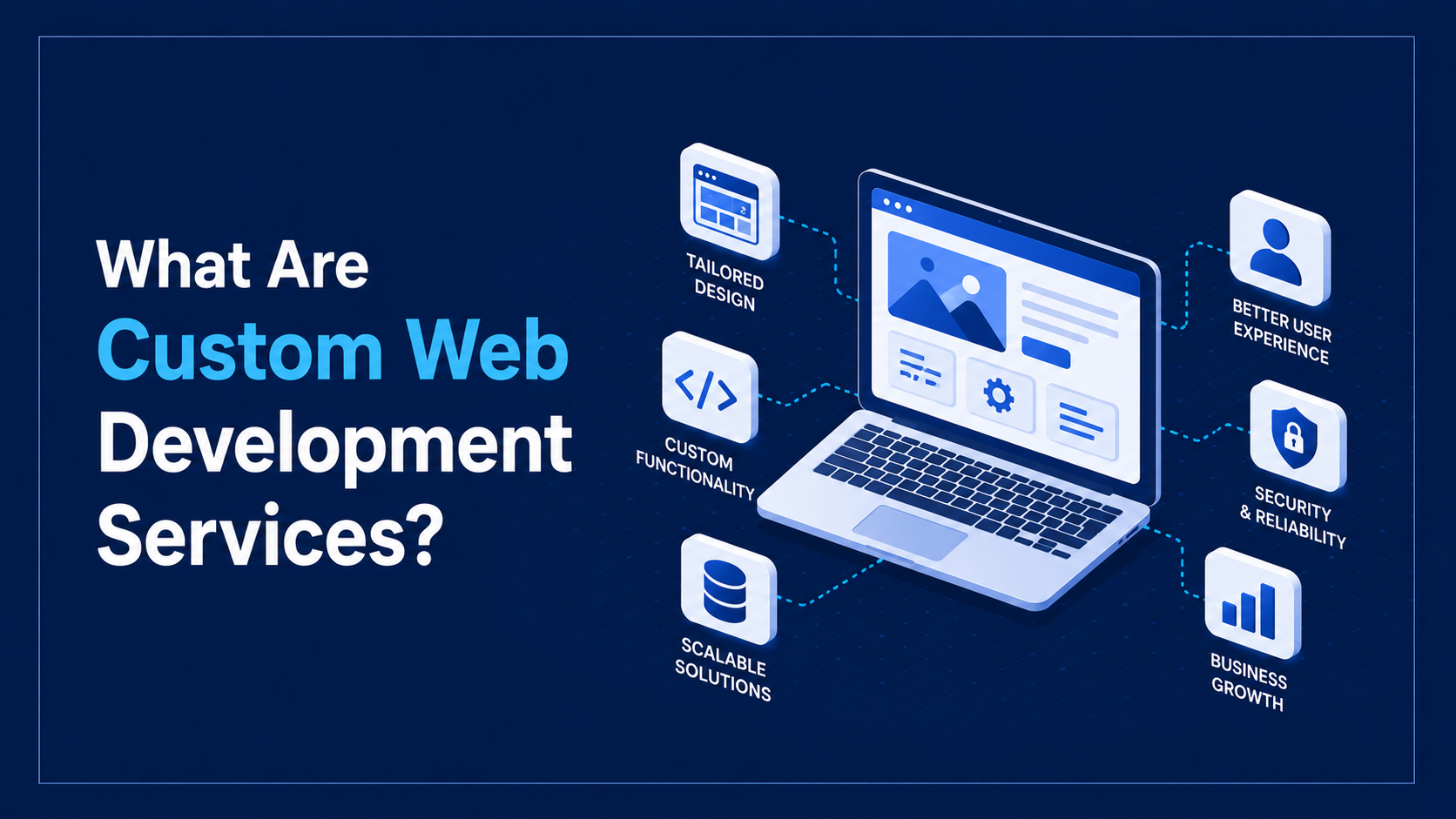
Business-specific functionality: Build features around your actual processes instead of adapting to a fixed platform.
Scalability: Add new features, users, integrations, and workflows as the business grows.
Flexibility: Change or extend the solution when business requirements evolve.
Better integrations: Connect the website with CRM, ERP, payment systems, APIs, or other business tools.
Security and control: Build security measures around the application's architecture and business requirements.
Better user experience: Design the interface and user journey around the needs of your customers and team.
The key advantage is control. Instead of choosing a platform first and adjusting your business around it, custom development lets you build technology around how your business actually operates.
What Does Custom Web Development Include?
Custom web development can cover different parts of a website or web application, depending on the business requirements. The main areas include:
UI/UX design: Research, wireframes, prototypes, navigation, and interface design focused on creating a clear and usable experience.
Front-end development: Builds the parts of the website users interact with, including responsive layouts and interactive features.
Back-end development: Handles business logic, databases, authentication, APIs, and server-side functionality.
Database development: Organizes and manages the data the application needs to store, retrieve, and process.
API and third-party integrations: Connects the website with tools such as CRMs, payment gateways, ERP systems, analytics platforms, and other business applications.
CMS and e-commerce functionality: Adds content management, product catalogs, payments, orders, and other capabilities when required.
Not every project needs all of these components. The right technology and features depend on what the website needs to accomplish and how the business operates.
How Does the Custom Web Development Process Work?
A custom web development project usually moves through several stages, from understanding the business requirements to launching and maintaining the final solution.
1. Discovery and Requirements
The team first defines the business goals, target users, required features, integrations, and technical requirements. This helps establish the project scope before development begins.
2. UI/UX Design and Prototyping
Designers create wireframes and prototypes to plan the user journey, navigation, and interface. Testing these flows early can help identify usability issues before development starts.
3. Development
Developers build the front end, back end, database, APIs, and other required functionality based on the approved design and requirements.
4. Testing and Quality Assurance
The website is tested for functionality, responsiveness, performance, security, and compatibility across relevant devices and browsers. Performance should also be measured using user-focused metrics. Google's Core Web Vitals evaluate loading performance, visual stability, and responsiveness, helping teams assess the real-world experience of a website.
5. Deployment
Once testing is complete, the website or web application is deployed to the production environment and made available to users.
6. Maintenance and Support
After launch, ongoing maintenance can include bug fixes, security updates, performance improvements, and new features as the business evolves.
A structured process helps reduce avoidable issues and keeps design, development, and business requirements aligned from start to launch.
What Makes UI/UX Important in Custom Web Development?
UI/UX is an important part of custom web development because the website needs to be easy for users to understand and navigate.
Accessibility is also an important part of creating usable websites. Businesses can refer to the W3C Web Accessibility Initiative (WAI) for accessibility best practices.
A custom development process can include:
User research: Understand user needs, expectations, and common pain points.
Wireframing: Plan page structure, navigation, and key user flows before development.
Prototyping: Test how important pages and interactions will work before development begins.
Responsive design: Ensure the website works well across desktop, tablet, and mobile devices.
Usability testing: Identify confusing or difficult parts of the experience and improve them.
Visual design: Create a consistent interface that supports the brand and makes information easier to understand.
When UI/UX is considered early, businesses can identify usability issues before they become expensive development changes. It also helps ensure that the final website supports both user needs and business goals.
How Much Does Custom Web Development Cost?
The cost of custom web development depends on the scope and complexity of the project rather than a fixed price.
Key factors include:
Number and complexity of features
UI/UX and design requirements
Front-end and back-end development
Third-party integrations
Database and API requirements
Security requirements
Testing and quality assurance
Ongoing maintenance and support
A simple business website with a few custom features will generally require less development than a complex web application with multiple integrations, user roles, and automated workflows.
Before development begins, it's better to define the required features and priorities clearly so the budget reflects the actual business needs.
When Should You Choose Custom Web Development?
Custom development can make sense when a business has requirements that standard platforms cannot handle effectively.
You may want to consider custom development when:
Your business has unique workflows or processes.
Existing platforms require too many workarounds.
You need integrations with multiple business systems.
You expect the website or application to grow significantly.
You need specific functionality that isn't available in ready-made solutions.
You want greater control over the user experience and technology.
On the other hand, a template or ready-made platform may be enough if your requirements are simple and can be handled by existing features.
The right choice depends on the problem you're solving, not simply on whether custom development is available.
How Do You Choose the Right Custom Web Development Partner?
Choosing the right development partner is about more than technical skills. The team should understand your business requirements and be able to turn them into a practical solution.
Consider:
Relevant experience: Look for experience with projects similar to yours.
UI/UX capabilities: Make sure the team can design experiences around real user needs.
Technical expertise: Check whether they have the skills needed for your technology stack and integrations.
Communication: Clear communication helps keep requirements, timelines, and expectations aligned.
Testing and security: Ask how the team handles quality assurance and application security.
Post-launch support: Understand how maintenance, improvements, and future development will be handled.
A strong development partner should be able to explain why a particular technology or approach makes sense for your business, rather than simply recommending tools.
Frequently Asked Questions About Custom Web Development
1. What is custom web development?
Custom web development is the process of designing and developing a website or web application around a business's specific requirements, workflows, users, and goals.
2. How is custom web development different from template-based development?
Template-based development uses pre-built designs and functionality, while custom development allows businesses to create features, workflows, integrations, and user experiences based on their specific requirements.
3. How long does custom web development take?
The timeline depends on the project's scope, features, design requirements, integrations, testing, and technical complexity. A simple website can take less time than a complex web application.
4. How much does a custom website cost?
There is no single fixed cost. Pricing depends on factors such as features, design, integrations, technology, testing, security, and ongoing support.
5. Is custom web development better for growing businesses?
It can be a good option when a business needs flexibility, unique functionality, integrations, or the ability to scale beyond what a standard platform provides.
6. Can custom websites integrate with existing business systems?
Yes. Custom websites and web applications can be built to integrate with systems such as CRMs, ERPs, payment gateways, APIs, analytics platforms, and other business tools.
Conclusion
Custom web development isn't automatically the right choice for every business. Its value comes from building technology around specific business needs rather than forcing those needs into a fixed platform.
From UI/UX and custom functionality to integrations, scalability, and ongoing support, the right solution should make your business processes easier to manage and give you room to grow.
If your existing website or platform doesn't fit your workflows, custom web development can help you create a solution that works around your business goals and user needs.
Looking to build or improve a custom website or web application? Netizens Technologies can help you plan and develop a solution around your workflows, integrations, and business goals.
Your Product Could Be the
Next Case Study
Explore what we’ve built — and let’s collaborate to create something impactful for your business.
We reply within 24 business hours.