How Continuous Deployment Lets Your Business Push Updates Without the Panic

TL;DR / Summary
Simplify software releases with continuous deployment services. Automate deployments, reduce risk, improve release quality, and deliver updates with confidence.
Table of Contents
- Why Software Releases Still Feel Like High-Risk Events
- The Hidden Cost of Manual Deployments
- Continuous Deployment vs Traditional Deployments
- What Continuous Deployment Actually Means for Your Business
- How Our Continuous Deployment Services Reduce Deployment Risk
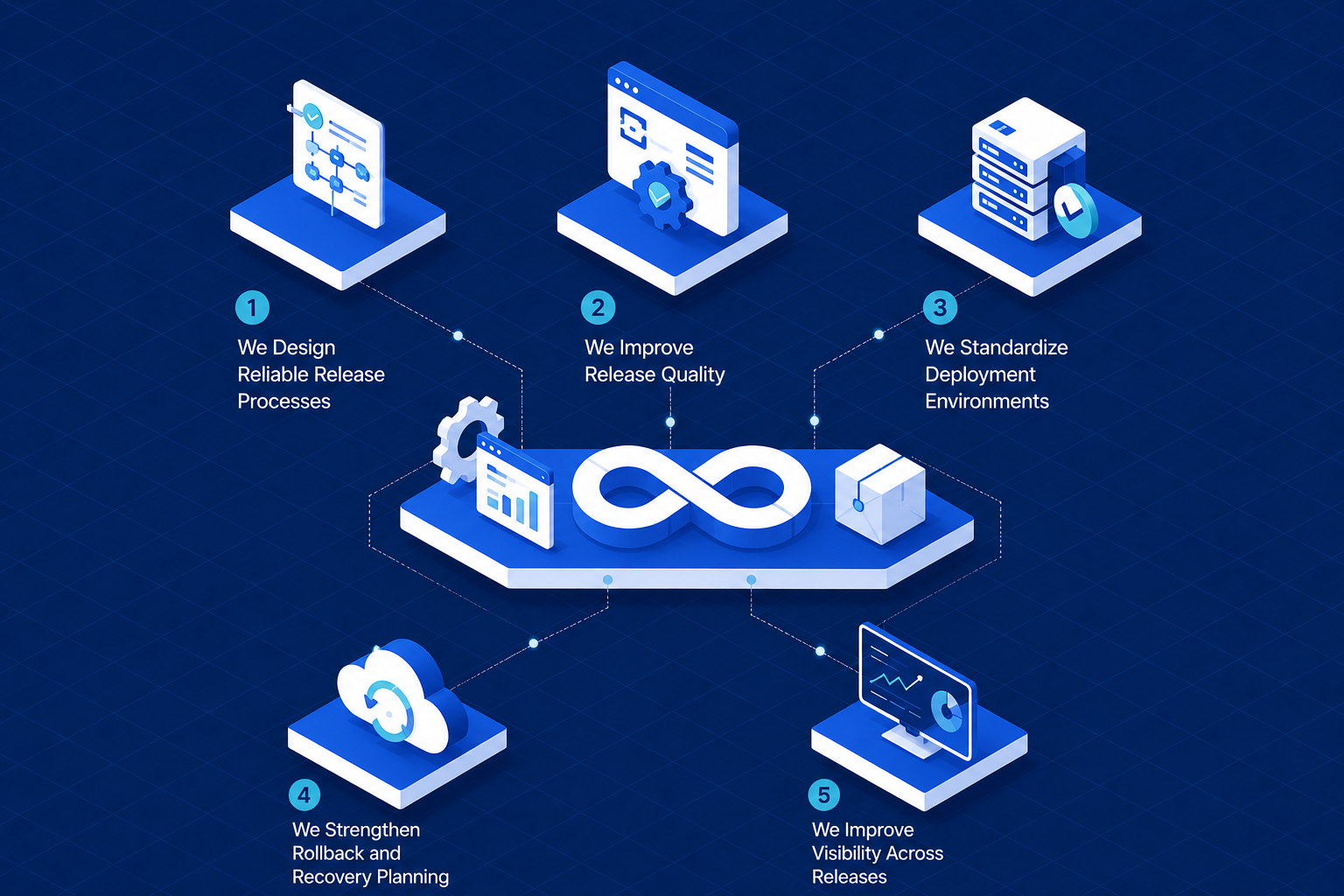
- We Design Reliable Release Processes
- We Improve Release Quality
- We Standardize Deployment Environments
- We Strengthen Rollback and Recovery Planning
- We Improve Visibility Across Releases
- What Changes After Continuous Deployment Is Implemented
- Business Results Companies Typically See
- Signs Your Business Has Outgrown Its Current Deployment Process
- Our Approach to Continuous Deployment Implementation
- FAQs
- 1. What are continuous deployment services?
- 2. Is continuous deployment suitable for every business?
- 3. Does continuous deployment increase deployment risk?
- 4. What are the benefits of continuous deployment services?
- 5. Can continuous deployment work with existing CI/CD pipelines?
- 6. How do I know if my business needs continuous deployment services?
- Stop Treating Deployments Like Emergencies
Software updates shouldn't feel like high-risk events.
Yet for many businesses, every release comes with the same routine. Teams schedule deployments late at night to avoid disrupting customers. Developers stay online after working hours in case something breaks. Operations teams prepare rollback plans before the update even starts. Everyone waits and watches dashboards, hoping the release goes smoothly.
When pushing a simple update feels stressful, the problem usually isn't your team. It's the deployment process.
Continuous deployment services help businesses replace stressful manual releases with automated, reliable deployment processes. Instead of treating releases like major events, they become routine operations that happen consistently and safely.
If your business wants to move faster without increasing risk, continuous deployment is often the missing piece.
Why Software Releases Still Feel Like High-Risk Events
Most businesses don't struggle because their teams aren't capable. They struggle because their release process depends too heavily on manual work.
A typical deployment often includes manual approvals, deployment checklists, server updates, configuration changes, testing steps, and coordination between multiple teams. Every extra step creates another opportunity for delays or mistakes.
The result is predictable.
Teams avoid releasing on Fridays. Major updates get delayed for weeks. Small changes are bundled together into larger deployments that become harder to test and harder to roll back.
Eventually, deployment itself becomes the bottleneck that slows the entire business down.
The Hidden Cost of Manual Deployments
Deployment problems affect far more than the IT department.
When releases take too long, product improvements reach customers later than planned. Sales teams wait longer for requested features. Customer issues take longer to resolve. Competitors move faster.
Manual deployment processes can also increase operational costs.
Instead of focusing on innovation, skilled engineers spend significant time preparing releases, coordinating teams, managing approvals, and monitoring deployments.
Some of the most common business impacts include:
Delayed product launches and feature releases
Increased downtime caused by release issues
Higher operational overhead during deployments
Reduced engineering productivity
Slower response to customer feedback and market demands
Greater dependency on key personnel during release cycles
Then there is the cost of inconsistency.
A missed configuration change or overlooked deployment step can quickly lead to downtime, failed transactions, customer complaints, and emergency fixes.
What looks like a technical issue often becomes a business problem surprisingly fast.
Continuous Deployment vs Traditional Deployments
Traditional Deployments | Continuous Deployment |
Manual release process | Automated deployments |
Monthly or scheduled releases | Frequent updates |
High deployment risk | Lower deployment risk |
Long release windows | Smaller, continuous releases |
Heavy manual approvals | Automated validation workflows |
What Continuous Deployment Actually Means for Your Business
Continuous deployment is not about deploying faster for the sake of speed.
It is about creating a release process that is reliable enough to happen automatically.
Every code change moves through predefined validation steps such as testing, security checks, and quality verification before reaching production. If the change passes all checks, deployment happens automatically without requiring manual intervention.
Instead of releasing large batches of changes once every few weeks, businesses deploy smaller updates continuously.
Smaller releases are easier to test, easier to monitor, and easier to reverse if necessary.
The biggest benefit is confidence.
Your team stops asking, "What might break during deployment?" and starts treating releases as routine business operations.
How Our Continuous Deployment Services Reduce Deployment Risk
Successfully adopting continuous deployment requires more than simply introducing new tools or processes.
Our approach focuses on creating a deployment strategy that aligns with your infrastructure, operational requirements, compliance needs, and business goals.
We Design Reliable Release Processes
Many deployment challenges come from inconsistent release practices and undocumented procedures.
We help businesses establish structured and repeatable deployment processes that improve reliability and reduce operational risk.
We Improve Release Quality
Frequent releases only work when quality remains consistent.
We help teams strengthen testing practices, validation workflows, and release readiness checks to reduce issues reaching production environments.
We Standardize Deployment Environments
One of the most common deployment challenges is simple:
"It worked in staging but failed in production."
We help organizations create consistency across environments so deployments behave predictably from testing through production.
We Strengthen Rollback and Recovery Planning
Even mature deployment processes occasionally encounter issues.
We help businesses establish rollback procedures and recovery strategies that minimize disruption and reduce downtime when problems occur.
We Improve Visibility Across Releases
Successful deployments require visibility into release health and application performance.
We help teams improve monitoring, reporting, and operational awareness so issues can be identified and addressed quickly. Using tools such as Jenkins, GitHub Actions, Bamboo, GitLab CI/CD, Azure DevOps, and CircleCI, we enable better visibility into deployment pipelines, release progress, build status, and application health. This allows teams to detect issues early, respond faster, and maintain reliable software releases.
What Changes After Continuous Deployment Is Implemented
The transformation is usually noticeable almost immediately.
Monthly release windows give way to updates that can happen multiple times each week.
Deployments no longer need to be scheduled outside business hours. Releases can happen during normal operations.
Lengthy deployment meetings and manual approvals are replaced by predefined automated workflows.
Deployment anxiety is replaced with confidence across development and operations teams.
The goal is not simply to release more often.
The goal is to make deployments boring.
For operations teams, boring deployments are usually the sign of a mature and reliable delivery process.
Business Results Companies Typically See
Continuous deployment creates operational improvements, but the business impact goes much further.
Businesses often see faster delivery of new features and customer requests.
Operational overhead decreases because teams spend less time managing releases manually.
Downtime and deployment-related incidents become less frequent.
Engineering teams become more productive because they spend more time building and less time coordinating releases.
Most importantly, businesses gain the flexibility to respond to customers and market changes much faster than competitors still relying on manual deployment processes.
Signs Your Business Has Outgrown Its Current Deployment Process
If any of these situations sound familiar, your deployment process may be limiting growth:
Your releases require multiple teams to coordinate manually.
Deployments are scheduled during evenings or weekends.
Your team avoids releasing before holidays or major business events.
Rollback procedures exist only in internal documentation.
Releases happen monthly because deployments are considered risky.
A single deployment issue can consume an entire day of engineering time.
Your deployment process depends heavily on one or two key employees.
Small improvements are delayed while waiting for larger release windows.
These are often signs that your release process needs modernization and better operational practices.
Our Approach to Continuous Deployment Implementation
Every business has different infrastructure, technologies, and operational requirements.
That is why implementation should never follow a one-size-fits-all approach.
We begin by evaluating your current release process and identifying bottlenecks, risks, and opportunities for process improvement.
From there, we design and implement deployment pipelines tailored to your systems and business objectives. Depending on your existing infrastructure and development workflow, we implement and optimize deployment pipelines using trusted CI/CD tools such as Jenkins, GitHub Actions, Bamboo, GitLab CI/CD, Azure DevOps, and CircleCI. Rather than forcing a specific platform, we recommend the tools that best fit your technology stack, scalability requirements, and deployment goals.
We then introduce testing, monitoring, rollback strategies, and operational visibility to ensure deployments remain safe and predictable.
Finally, we work with your teams to ensure adoption happens smoothly and that the new process supports long-term growth.
FAQs
1. What are continuous deployment services?
Continuous deployment services automate software releases, allowing validated code changes to reach production quickly with minimal manual effort.
2. Is continuous deployment suitable for every business?
It works best for businesses that release software regularly and want faster, more reliable, and scalable deployments.
3. Does continuous deployment increase deployment risk?
No. Automated testing, validation, and monitoring, it often reduce deployment errors and improve release consistency.
4. What are the benefits of continuous deployment services?
They help reduce deployment time, improve release quality, minimize downtime, and increase engineering productivity.
5. Can continuous deployment work with existing CI/CD pipelines?
Yes. Continuous deployment services can enhance and integrate with your existing CI/CD pipeline and deployment workflows.
6. How do I know if my business needs continuous deployment services?
If deployments are manual, time-consuming, or risky, continuous deployment services can help modernize your release process and improve efficiency.
Stop Treating Deployments Like Emergencies
Your business should not need deployment war rooms, late-night release schedules, or emergency rollback plans every time an update goes live.
Continuous deployment allows your team to release faster, reduce risk, and focus on delivering value instead of managing deployments.
If your current release process feels stressful, expensive, or difficult to scale, now is the right time to modernize it.
Ready to remove deployment anxiety from your business operations?
Let's explore how continuous deployment can help your team ship updates with confidence.
Your Product Could Be the
Next Case Study
Explore what we’ve built — and let’s collaborate to create something impactful for your business.
We reply within 24 business hours.