IT Support for Startups: From Idea to MVP Development and Scaling

TL;DR / Summary
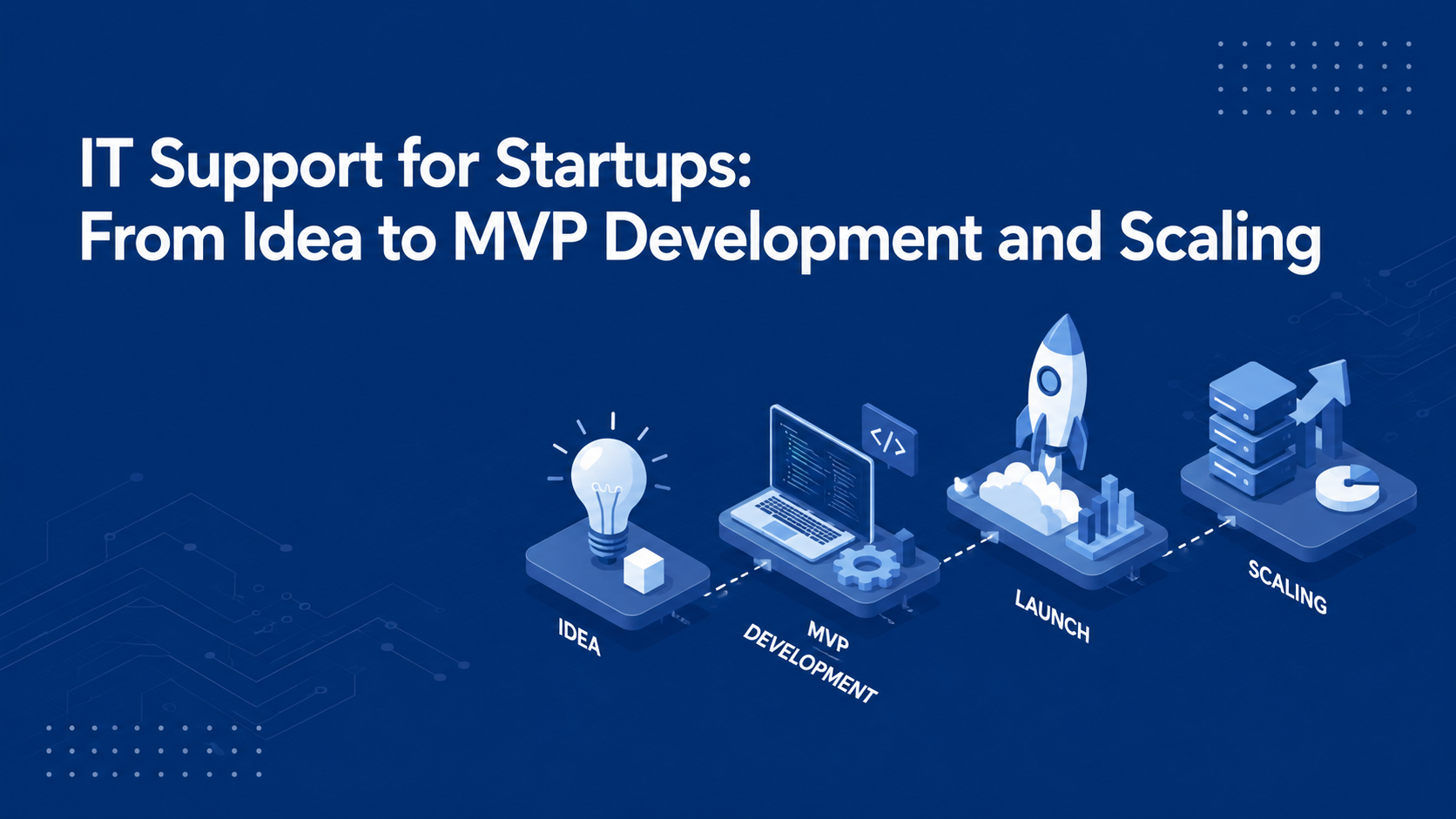
Explore IT support for startups, from idea and MVP development to launch, maintenance, and scaling your product for growth.
Table of Contents
- What IT Support Do Startups Need for MVP Development?
- 1. Validate Your Startup Idea With Market and Feasibility Research
- Market research
- Competitor analysis
- Technical feasibility
- Financial feasibility
- 2. Define the MVP Before Building the Full Product
- 3. Build a Prototype or Proof of Concept
- 4. Choose the Right Development Model
- Co-development
- Outsourced development
- Staff augmentation
- 5. Create Clear Responsibilities and Expectations
- 6. Maintain Strong Communication During Development
- 7. Develop, Test, and Improve the MVP
- 8. Plan for Maintenance and Ongoing IT Support
- 9. Prepare the Product for Growth
- How to Choose the Right IT Partner for Your Startup
- Look for relevant experience
- Evaluate the full range of services
- Assess communication
- Check flexibility
- Clarify ownership and security
- Consider post-launch support
- Why the Right IT Partner Matters for MVP Success
- Frequently Asked Questions
- 1. What is the purpose of an MVP?
- 2. Why is IT support important for startups?
- 3. What is co-development in software development?
- 4. Should a startup outsource MVP development?
- 5. How do I choose an MVP development partner?
- 6. What happens after an MVP is launched?
Every startup begins with an idea, but turning that idea into a product people actually want is a different challenge. Before investing heavily in development, founders need to understand the market, validate the concept, define the right features, and determine whether the product is technically and financially feasible.
This is where the right IT development partner can make a difference.
An experienced technology partner can support a startup beyond writing code. They can help with market research, feasibility analysis, prototyping, MVP development, testing, deployment, ongoing maintenance, and scaling. They can also work alongside an internal team through a co-development model or take responsibility for specific parts of the product through outsourcing.
The goal is not simply to build an MVP quickly. It is to build the right MVP, learn from real users, improve the product, and create a technical foundation that can support future growth.
What IT Support Do Startups Need for MVP Development?
Startups may need IT support at every stage of the product journey, from validating an idea and building an MVP to launching, maintaining, and scaling the product.
Market and competitor research - Understand your target market, customers, and competitors before development begins.
Technical and financial feasibility analysis - Determine whether the product is technically possible and financially practical.
Product and feature planning - Identify and prioritize the features needed for the MVP.
Prototype and proof-of-concept development - Test the product concept and technical approach before full development.
MVP development - Build the core product with the essential features needed for initial users.
UI/UX design - Create a simple, intuitive, and user-friendly product experience.
Testing and quality assurance - Find and fix bugs, usability issues, and performance problems before launch.
Deployment and launch support - Prepare, deploy, and monitor the product during its launch.
Maintenance and updates - Fix issues, improve performance, and keep the product updated after launch.
Infrastructure and scalability - Build and improve the technical infrastructure to support future growth.
Ongoing technical support - Provide continued troubleshooting, improvements, and technical assistance as the startup grows.
The exact level of support depends on the startup's internal capabilities. A startup with an experienced engineering team may need additional specialists, while a non-technical founding team may need an external partner to manage most of the product development process.
1. Validate Your Startup Idea With Market and Feasibility Research
A strong MVP starts before development begins.
Founders often have a clear vision for what they want to build. Still, they may not yet know whether customers need it, how competitors solve the same problem, or whether the proposed solution is technically practical.
An IT partner can help evaluate the idea from both a business and technical perspective.
Market research
Market research helps determine whether the product addresses a genuine need and where it could fit within the existing market. It can also reveal which platforms, features, and user experiences are expected by the target audience.
Competitor analysis
Studying competing products helps identify what already exists and where there may be room for differentiation. Instead of trying to copy every feature competitors offer, startups can focus their MVP on the capabilities that matter most to their target users.
Technical feasibility
An idea may sound simple but require complex integrations, infrastructure, security controls, or third-party services.
A feasibility assessment helps determine whether the proposed product can realistically be built within the available technology, budget, and timeline.
Financial feasibility
Startups also need to understand how much they should invest before they have evidence of market demand. A feasibility assessment can help identify unnecessary features and prevent the team from spending its limited budget on functionality that does not contribute to the core product.
2. Define the MVP Before Building the Full Product
An MVP is not simply a smaller version of the final product.
Its purpose is to deliver the minimum set of features needed to test the core product idea with real users.
Before development starts, the startup and development partner should agree on:
Who the target users are - Identify the specific audience the product is designed for.
What problem the product solves - Define the main problem or need the product addresses.
What the core user journey looks like - Map the key steps users will take when using the product.
Which features are essential for the first release - Prioritize the features required to make the MVP useful.
Which features can wait - Identify non-essential features that can be added in future versions.
Which platform or platforms are required - Decide whether the product should launch on web, mobile, or both.
How the product will generate value or revenue - Define how the product will benefit the business or make money.
What success will be measured against - Set clear metrics to evaluate the MVP's performance.
This step is particularly important when working with an external development team. Clear requirements reduce misunderstandings and give developers enough context to make better technical decisions.
3. Build a Prototype or Proof of Concept
Once the core requirements are clear, the next step may be creating a prototype or proof of concept.
A prototype allows founders to visualize how the product will work before committing to full development. It can also be used to collect early feedback from potential users, investors, or internal stakeholders.
A proof of concept can answer a different question: Can the proposed technical approach actually work?
For example, a startup may need to confirm that a particular API integration, data workflow, AI capability, or system architecture is technically achievable before investing in the complete MVP.
This approach can reduce the cost and risk of discovering major problems after development is already underway.
4. Choose the Right Development Model
Not every startup needs the same type of development support.
Depending on the team's skills, budget, timeline, and product requirements, startups can work with an external partner through different models.
Co-development
Co-development allows the startup's internal team and an external development team to work together on the same product.
Responsibilities can be divided according to expertise. For example, the internal team may handle product decisions and business requirements while the external team contributes engineering, UI/UX, testing, or specialized technical expertise.
This model can work well when a startup already has technical resources but needs additional capacity or specialist skills.
Outsourced development
With outsourcing, an external development team takes responsibility for defined parts or most of the development process.
This can be useful when a startup does not have enough internal engineering resources to build the product independently.
The key is to establish clear responsibilities, deliverables, timelines, communication processes, and ownership before development begins.
Staff augmentation
A startup may also bring in external developers to strengthen an existing team temporarily.
This can be useful when the company needs additional capacity for a specific technology, development phase, or deadline without building a permanent internal team.
The right model depends on what the startup already has and what it needs to accomplish.
5. Create Clear Responsibilities and Expectations
Working with multiple teams can accelerate development, but only when everyone understands their responsibilities.
At the beginning of the project, define:
Project scope - Clearly define what the project will and will not include.
Roles and responsibilities - Assign clear responsibilities to each team member.
Development milestones - Set key stages and targets throughout the development process.
Deliverables - Specify what the development team is expected to provide.
Communication channels - Decide how and where teams will communicate and share updates.
Review and approval processes - Establish how work will be reviewed, approved, or revised.
Deadlines - Set realistic timelines for completing each project stage.
Payment terms - Agree on the payment schedule, costs, and billing conditions.
Testing responsibilities - Define who will test the product and handle identified issues.
Intellectual property ownership - Clarify who owns the code, designs, data, and other project assets.
Security and compliance requirements - Define the security measures and regulations the product must follow.
This becomes especially important in co-development projects where internal and external teams share responsibility.
Without clear ownership, tasks can be duplicated, missed, or delayed.
A shared project plan gives everyone a common reference point and makes it easier to track progress.
6. Maintain Strong Communication During Development
Communication should not stop once development begins.
Startups should establish a regular process for discussing progress, questions, blockers, feedback, and upcoming deliverables.
Depending on the project, this might include:
Regular progress meetings
Sprint planning
Development reviews
Shared project management tools
Documentation
Technical discussions
Product demonstrations
Developers should also be encouraged to ask questions when requirements are unclear.
This is important because developers may identify technical limitations or better implementation options that founders have not considered.
Good collaboration is not about the startup telling the development team exactly how to build everything. It is about combining product knowledge with technical expertise to reach the best solution.
7. Develop, Test, and Improve the MVP
Once the requirements and development plan are established, the team can move into development.
An effective process typically breaks the product into smaller milestones rather than attempting to build everything at once.
A typical MVP development process may include:
Planning → Prototype/POC → Development → Testing → Deployment → Feedback
Testing should happen throughout development, not only at the end.
Functional testing verifies whether features work as expected, while usability and performance testing can identify problems that affect the user experience.
The objective is to release a stable product that is good enough to generate meaningful feedback without spending unnecessary time building features that have not yet been validated.
8. Plan for Maintenance and Ongoing IT Support
An MVP still needs support after launch.
Bugs need to be fixed, dependencies may need updates, security issues need attention, and users may encounter problems that were not identified during initial testing.
Ongoing IT support can include:
Bug fixes
Performance improvements
Security updates
Technical monitoring
Infrastructure management
Feature enhancements
User support
Compatibility updates
Working with the same development partner can be beneficial because the team already understands the product's architecture, codebase, and development history.
9. Prepare the Product for Growth
A successful MVP can create a new challenge: rapid growth.
As the number of users, transactions, integrations, and data increases, the technical infrastructure may need to evolve.
A startup should therefore consider scalability during MVP development without overengineering the first version.
The goal is to create an architecture that can grow as the product gains traction.
This may involve planning for:
Increased user traffic - Prepare the product to handle more users and requests without slowing down.
Larger data volumes - Ensure the system can store and process growing amounts of data efficiently.
Additional integrations - Add new third-party tools, APIs, and services as business needs grow.
New platforms - Extend the product to additional platforms such as mobile, web, or desktop.
Improved security - Strengthen security measures to protect users, data, and systems as the product grows.
Infrastructure scaling - Upgrade servers, cloud resources, and other infrastructure to support increased demand.
Performance optimization - Improve speed, reliability, and responsiveness as usage increases.
Having an IT partner involved from the early stages can make this transition easier because the team already understands the product and its technical foundation.
How to Choose the Right IT Partner for Your Startup
Choosing a development partner is about more than comparing hourly rates.
The right partner should understand your product goals and be able to support the project as those goals evolve.
Look for relevant experience
Software development experience is useful, but relevant experience is even more valuable.
Review previous projects and look for evidence that the partner has worked with similar technologies, industries, product types, or business challenges.
Evaluate the full range of services
Your requirements may change as the startup grows.
A partner that can support development, testing, maintenance, cloud infrastructure, mobile applications, and other technology needs can reduce the need to coordinate multiple vendors later.
Assess communication
A technically strong team can still become difficult to work with if communication is inconsistent.
Ask how the team handles progress updates, questions, feedback, documentation, and project changes.
Check flexibility
Startups often change direction after receiving user feedback.
Your development partner should be able to adapt the product roadmap without losing control of the project scope, timeline, and budget.
Clarify ownership and security
Before development begins, make sure agreements clearly address intellectual property, access to source code, data security, confidentiality, and ownership of deliverables.
Consider post-launch support
MVP development is only one stage of the product journey.
Ask what support the partner can provide after launch and whether they can help maintain, improve, and scale the product as your startup grows.
Why the Right IT Partner Matters for MVP Success
A startup does not need to build everything at once.
It needs to make the right decisions at each stage.
An experienced IT partner can help founders move from an initial idea to research, prototype, MVP development, launch, feedback, and ongoing improvement. They can also provide specialized expertise when internal resources are limited or work alongside an existing team through co-development.
The biggest advantage is not simply having more developers. It is having the right technical experience involved when important product and development decisions are being made.
For startups, that can mean spending less time building the wrong product and more time learning what customers actually need.
Frequently Asked Questions
1. What is the purpose of an MVP?
An MVP provides the essential functionality needed to test a product idea with real users. It helps startups gather feedback and validate assumptions before investing in a full-scale product.
2. Why is IT support important for startups?
IT support can help startups with feasibility analysis, product development, testing, deployment, maintenance, security, and scaling. It can also give startups access to technical expertise they do not have internally.
3. What is co-development in software development?
Co-development is a collaborative approach where internal and external teams share responsibilities for building a software product. Each team contributes according to its skills and works toward shared product goals.
4. Should a startup outsource MVP development?
Outsourcing can be useful when a startup lacks the internal resources or expertise required to build its MVP. The right approach depends on the startup's budget, technical capabilities, timeline, and product requirements.
5. How do I choose an MVP development partner?
Look for relevant experience, technical expertise, clear communication, flexible engagement models, transparent project planning, strong security practices, and reliable post-launch support.
6. What happens after an MVP is launched?
After launch, startups should monitor user behavior, collect feedback, fix issues, and prioritize improvements based on real-world usage. If the product gains traction, the next stage is to improve the product and scale its technology infrastructure.
Related Blogs & Articles
Your Product Could Be the
Next Case Study
Explore what we’ve built — and let’s collaborate to create something impactful for your business.
We reply within 24 business hours.